
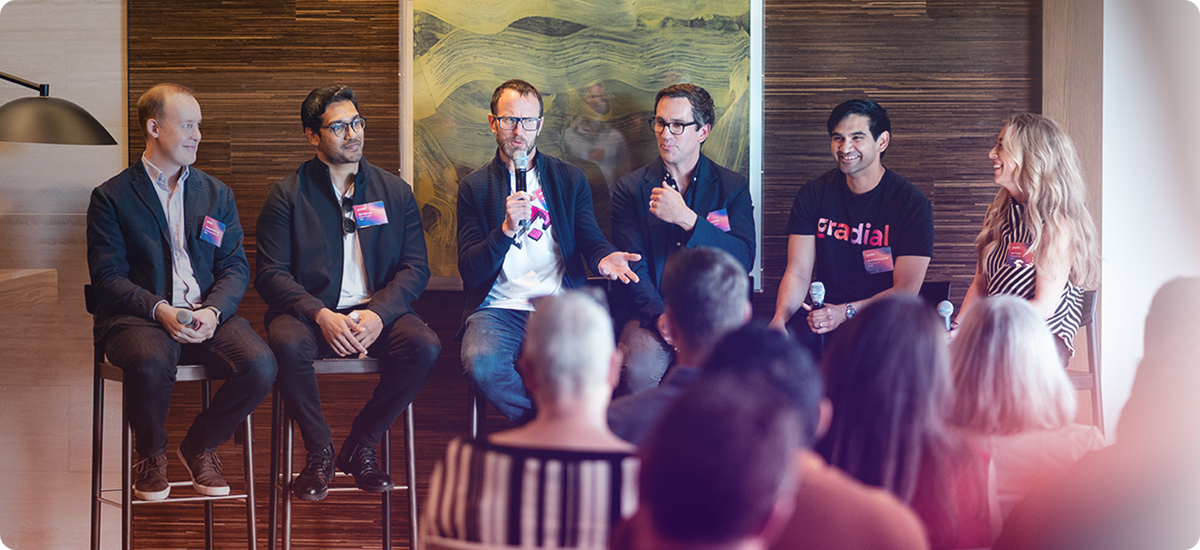
Last week, we opened the doors to our new Seattle headquarters and welcomed over 100 marketing leaders, executives, and colleagues. The rooftop was incredible, but what mattered most were the conversations about how marketing teams are evolving and what’s possible now.
AI Summary
- Gradial’s new Seattle HQ opened with over 100 leaders discussing the future of enterprise marketing.
- Panelists from T-Mobile, Milliman, AWS, and Gradial agreed that traditional workflows can’t keep pace with today’s demands.
- T-Mobile shared proof of impact: 1,700 hours of manual work cut to 85 with oversight—or just 20 fully automated.
- The panel showed that speed and governance no longer conflict, with accessibility, brand, and legal checks built directly into workflows.
- The bigger theme was clear: enterprise marketing is shifting from manual production to orchestrated execution, freeing teams for strategy and innovation.
Honest Talk About Enterprise Marketing
The afternoon centered on a panel moderated by Jen Travis from Slalom, with leaders from T-Mobile, Milliman, AWS, and Gradial. We heard candid perspectives from people on the front lines of transformation.
The message was clear: enterprise marketing has reached a turning point. Teams are expected to scale output dramatically, deliver personalization at new levels, and keep governance airtight. The old way of working simply doesn't keep pace.
As Gene McKenna from T-Mobile put it:
“We make 20,000 changes a year to our site. Next year it’ll be 30,000. At the same time, I’ve been told we need to cut costs by 80% and increase output 10x. How do you do both?”
The 95% Time Reduction That Changed Everything
The most talked-about moment came when one panelist shared the impact of moving execution into Gradial:
Before Gradial: 1,700 hours of manual work to update 700 web pages for a new product launch
After Gradial: 85 hours with human oversight—or just 20 hours fully automated
Accuracy rate: 99.9%
The room went quiet. It was proof that agentic marketing is already delivering real results.
And this wasn't just a one-time event. As McKenna explained, T-Mobile has similar large-scale updates about once a month—new regulations, product launches, seasonal campaigns. For their day-to-day content updates, Gradial consistently saves about 95% of time across 70% of their workload.
Speed and Governance Together
For years, enterprise teams assumed speed meant sacrificing control. The panel made it clear that's no longer the case.
Accessibility compliance, brand standards, and even legal reviews are now embedded directly into automated workflows. The result is faster execution and stronger governance than manual processes ever allowed.
As one panelist noted, having AI automatically apply W3C guidelines and manage digital asset metadata at scale means teams can't forget the 5,000 things required for accessibility compliance—the system handles it consistently every time.
From Creation to Orchestration
What emerged was a bigger theme: enterprise marketing is shifting from endless production cycles to orchestrated execution. Instead of spending most of their time chasing tickets and approvals, marketers can focus on:
- Designing strategic campaigns
- Improving customer experiences
- Analyzing performance and iterating
- Driving collaboration across functions
Agentic marketing isn’t about replacing people. It’s about freeing them to do the work that matters most.
Multiplayer Marketing in Action
During the live demo, we showed how this evolution looks in practice. Teams can now collaborate directly on content previews, leaving comments and feedback the same way they would in Figma, while AI agents execute changes in real-time across multiple systems simultaneously.
Instead of managing campaigns ticket by ticket, teams can assign entire campaigns to agents. Whether it's updating hundreds of pages for a product launch or creating personalized variants for different demographics, the work happens autonomously while teams focus on strategy and optimization.
What It Means for Leaders
The launch of our new HQ marked more than a company milestone. It underscored a shift already underway: agentic marketing moving from pilots to production-scale adoption.
For leaders, the night raised three big questions:
- Is your content infrastructure ready to support 10x growth?
- Are governance and brand standards built into your workflows, or patched after the fact?
- Are your teams stuck in execution, or being elevated into strategic roles?
Join the Conversation
This was just the beginning. We’ll continue hosting executive roundtables, sharing case studies, and creating spaces where leaders can learn from each other.
Because the future of marketing execution isn’t built in isolation, it’s shaped in community.
Continue the story behind Gradial and its system of work.

Gradial
Gradial TeamGradial is a Seattle-based AI content operations platform built for enterprise marketing teams. From Fortune 500 brands to fast-moving partners, Gradial helps organizations plan, produce, and update content across CMS platforms like Adobe and Sitecore. Marketers use Gradial to move faster, reduce complexity, and focus on strategy over workflow.
Get updates from where the work gets done
Sign up to receive product releases, execution insights, and real-world use cases from the Gradial system of work.