
AI Summary
- AI visibility platforms can monitor brand presence and citations across leading AI engines.
- The real bottleneck is execution, turning recommendations into approved, published CMS updates.
- GEO demands always-on improvements because models and citation patterns change constantly.
- Gradial GEO closes the loop by identifying gaps and shipping fixes directly.
Gradial just launched a GEO Agent. Here's how it compares to the visibility tools like Profound, and why we think the category has been missing something important.
If you've been shopping for a GEO or AEO tool lately, you've seen no shortage of impressive platforms.
The category is fast-growing and increasingly crowded. Some of these tools have raised hundreds of millions of dollars, earned "category leader" designations, and built genuinely sharp marketing around the promise of AI search visibility. The data they surface, hundreds of millions of daily prompts tracked across ChatGPT, Gemini, Perplexity, and others, is real, and it's valuable.
We're not here to tell you those tools are bad. They aren't. We're here to ask a question that we think the GEO category has been quietly avoiding: after you get the report, who actually does the work?
That question has gone unanswered since SEO visibility tools took hold in the mid 2000s. Back then, nobody even knew to ask the question. We just accepted the insights and were totally okay with being given more work to do.
What Visibility Tools Do Well
Let's give credit where it's due, because the leading GEO platforms have built real things.
Visibility monitoring has gotten genuinely good. You can see exactly how your brand appears across AI engines, track your share of citations against competitors, and watch your brand sentiment shift over time. If you want a live dashboard of your AI search presence, there are solid options that give you a genuinely detailed one.
But visibility itself is table stakes. It's a feature, not a category. What's been missing is everything that happens after the insight: the actual execution.
The Gap Nobody Talks About
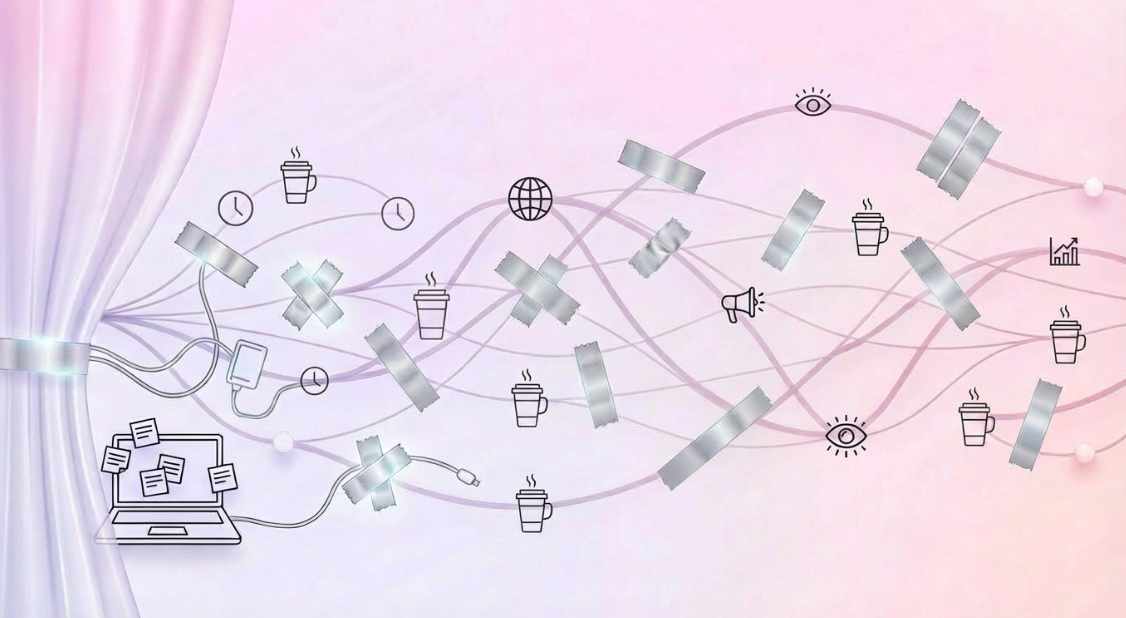
Here's the thing about visibility tools: the hard part isn't the seeing. It's the doing.
You get the report. It tells you that your competitor is cited 40% more often than you are for "best [your category] software." It shows you exactly which pages are underperforming. It flags that your FAQ section is missing three topics that AI engines keep pulling from competitors.
Now what?
Somebody has to write the new FAQ. Somebody has to update those underperforming pages, get them reviewed, get them through brand compliance, get them approved, and get them published into the CMS. That's not a visibility problem anymore. That's a content operations problem. And a good dashboard doesn't solve it.
And here's what makes GEO fundamentally different from every other marketing channel: it requires always-on execution. The AI models that power search are updated constantly. Their behavior shifts, their citation patterns change, new models enter the market. The optimizations you ship this week may need to be revisited next week. GEO is the first channel where being reactive isn't just inefficient. It's a direct path to lost revenue, because by the time you've manually implemented last month's recommendations, the landscape has already moved.
This is what we keep hearing from enterprise teams: the insights are excellent. The execution is on you. These platforms require a deep technical team to act on the recommendations they surface. And for most enterprise marketing orgs already stretched thin across campaigns, content, and compliance, "we'll figure out implementation later" is where good data goes to die. In a channel that demands continuous agility, a workflow that ends at a recommendation is a workflow that's already behind.
Where Gradial Comes In
Gradial was built for enterprise marketing operations. Think the messy, slow, people-heavy process between "we need better content" and "it's live on the website." Before GEO was a category, Gradial agents were already handling page authoring, QA, brand governance, accessibility checks, content migrations, and CMS publishing for companies like AWS, T-Mobile, and Prudential.
Last week, we launched Gradial GEO, and the difference from visibility-first tools isn't in the monitoring. It's in what happens after the monitoring.
For the first time in marketing history, there's a START button right on the insight.

Gradial GEO identifies where your brand is missing or outranked in AI search results, then executes the fixes directly. New pages get written, reviewed, and published. Existing pages get updated in the CMS. The process runs continuously, because AI models are constantly evolving and a quarterly audit isn't a strategy. It's a snapshot.
There's no ticket created. No backlog item assigned to an overwhelmed content team. No gap between "here's what's broken" and "here's it being fixed."
And because execution is tied directly to the recommendations, there's a built-in accountability loop. You don't get a report in one system and hope someone acts on it in another. The same platform that identifies the gap is the one that closes it, which means you can actually measure whether a recommendation moved the needle, not just whether someone got around to implementing it.
Who Each Approach Is Right For
A visibility-first GEO tool is a strong fit if:
- You're a company with a lean but technical marketing team
- Your primary need is monitoring and competitive intelligence
- You want deep insight into your AI search share of voice
- You have existing automated content workflows that just need better direction
Gradial is a strong fit if:
- You're an enterprise with a complex content supply chain
- You need GEO fixes to actually ship, not just be identified
- You're already managing content at scale in AEM, Workfront, or similar tools
- You want one platform that handles GEO alongside brand compliance, QA, accessibility, and content operations
The Honest Summary
The GEO category has built genuinely impressive visibility into the AI search era. These tools moved the market forward, and the industry is better for it.
But visibility without execution is a strategy deck, not a strategy. If your team is already stretched thin and the last thing you need is another dashboard telling you what's wrong without helping you fix it, that matters.
We built Gradial to close that loop. The GEO Agent isn't an add-on. It's the natural extension of an execution platform that's been running enterprise content operations at scale for two years.
The question isn't just where do you stand in AI search? It's who's going to do something about it?

Justin Hartford
Demand Generation, GradialJustin Hartford is a contributor at Gradial, writing about GEO, AI search visibility, and enterprise content operations.
Get updates from where the work gets done
Sign up to receive product releases, execution insights, and real-world use cases from the Gradial system of work.