
AI Summary
- Pharma content operations inside AEM are overwhelmed by manual workflows, creating slow launches, MLR rework, and compliance exposure.
- The bottleneck is not AEM’s capability. It is the operational layer between the decision to update and the moment every affected page is live.
- Bulk safety updates, fragmented global workflows, MLR rework cycles, and DAM metadata drift are the highest-cost execution gaps in pharma.
- Gradial agents work directly within AEM to execute page creation, bulk updates, compliance enforcement, localization, and DAM governance, turning weeks of manual work into days.
- For AEM-heavy pharma enterprises, the shift from manual authoring to agent-driven execution is not incremental. It is structural.
Pharmaceutical companies operate some of the most complex website ecosystems in enterprise: Global brand sites, HCP portals, patient education hubs, product microsites, country-specific variations, safety information updates, accessibility requirements, and at the center of it all, Adobe Experience Manager (AEM).
For most pharma organizations, AEM is a strategic, long-term investment. It’s powerful, flexible, and deeply integrated into the marketing stack. But even in AEM-heavy environments, the actual work of getting content live is still overwhelmingly manual, resulting in slower launches, expensive update cycles, MLR bottlenecks, compliance risk, and digital teams that are stretched thin.
The opportunity is how to unlock AEM.
The operational reality inside pharma + AEM
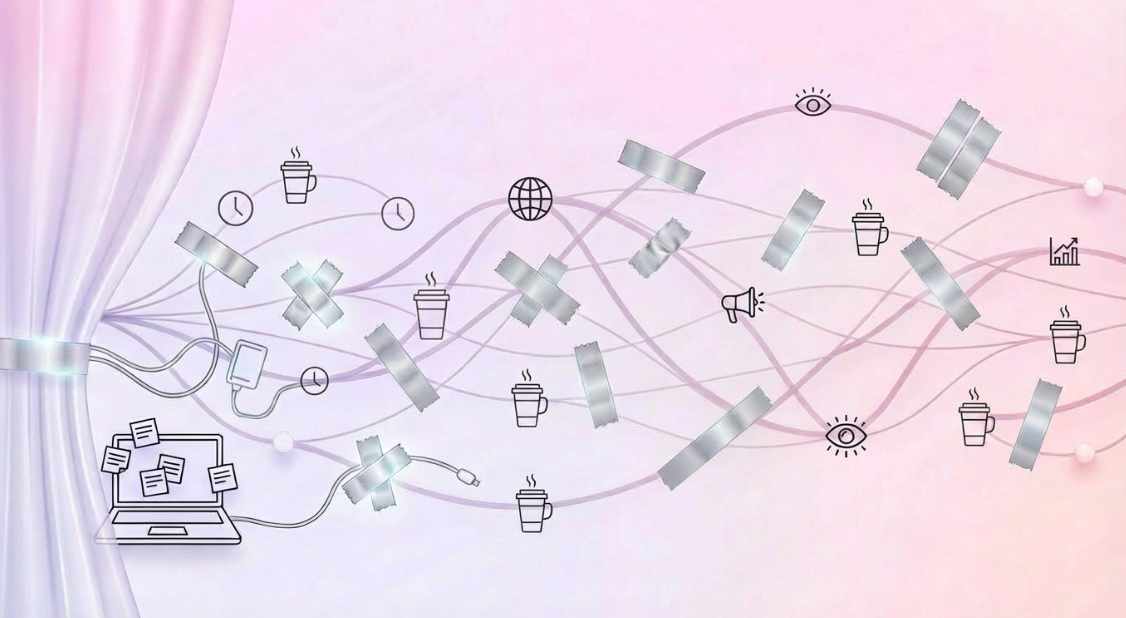
In theory, AEM provides enterprise-grade governance and scalability. In practice, content execution inside AEM often involves: creating a brief in Word or Figma, opening a ticket in Jira, manually authoring a page in AEM, uploaded and tagging assets in DAM, entering metadata by hand, reviewing accessibility after the build, manually incorporating MLR feedback, and the launch is delayed due to revision loops.
Multiply that by hundreds of pages, multiple sites for consumers and HCPs, different regulations for global markets, and each inefficiency compounds.
Here’s what makes pharma uniquely painful: you’re managing all of this while simultaneously navigating regulatory review across MLR, FDA, CMS, and local authorities; frequent label and safety updates that can’t wait; global localization and translation pipelines; strict brand governance; WCAG 2.2 accessibility compliance; regional personalization; and now, SEO and AI-search discoverability.
AEM can technically support all of it. But the operational layer, the way work actually moves through the system, is where time accumulates.
Where AEM-heavy pharma teams lose the most time
Bulk safety and label updates. When safety information changes, it rarely affects just one page.
ISI sections, boxed warnings, and dosage language can appear across HCP pages, patient sites, campaign microsites, archived content, and regional variations. Even with structured components, finding and updating every affected instance across a distributed page ecosystem is resource-intensive and high-risk when done manually.
The bottleneck isn’t AEM’s capability, it’s execution at scale.
Pharma organizations operating across global markets with dozens of stakeholders involved in every asset know this firsthand: the latency isn’t in the platform, it’s in the workflow between the decision to update and the moment every affected page is live.
MLR bottlenecks and rework. Medical, legal, and regulatory review is essential, but the way most teams execute it creates compounding delays.
Inconsistent claim language gets flagged. Accessibility gaps get discovered late. Brand rule violations surface after build. Metadata inconsistencies trigger resubmission. Every rejected submission means more time re-authoring inside AEM, and every rework cycle adds days or weeks.
Regulatory and legal teams often require visual proof of a before-and-after change, which can be cumbersome. With Gradial, you can easily export these to a PDF for approvals.
Fragmented global workflows. Global pharma organizations often operate in hub-and-spoke models: global brand develops master content, local markets adapt and translate, regional teams modify claims, country teams rebuild pages in AEM.
Even with Content Fragments and Experience Fragments, maintaining alignment across markets requires significant manual oversight. Without intelligent execution, duplication of effort becomes the default operating mode.
DAM and metadata drift. AEM’s DAM is powerful, but only if governance is enforced consistently. In many pharma environments, assets end up inconsistently tagged, metadata fields stay incomplete, taxonomies evolve without enforcement, and accessibility metadata goes missing.
Over time, discoverability declines and authoring slows. The operational cost quietly increases, and nobody notices until someone needs to find something urgently and can’t.
The strategic shift: from manual authoring to agent-driven execution
For AEM-heavy pharma enterprises, the next evolution isn’t adding another platform. It’s embedding operational intelligence into the one you already trust.
The question worth asking isn’t “How do we build this page?” It’s “How do we execute this page, compliantly, efficiently, and at scale, inside AEM?”
Leading, modern pharma organizations are moving towards a new operating model for their content: compliance-aware authoring where guardrails are applied before MLR review. Bulk update intelligence where changes are executed programmatically. Automated governance enforcement where metadata standards are maintained without manual policing. Structured localization workflows. Embedded accessibility validation during build, not after. Scalable page creation that doesn’t require an author for every page.
The content managment system transforms from a publishing tool into an execution engine. Gradial agents create or update AEM pages from Figma URLs, creative briefs, JIRA, Workfront, Microsoft Azure DevOps, Wrike, other tickets, or approved copy docs. Gradial uses existing core and custom components, content fragments, and experience fragments.
How Gradial unlocks AEM for pharma
For AEM-heavy pharma enterprises, Gradial is the system of work that bridges the gap between what AEM can do and what your team can actually execute day-to-day. Gradial agents work directly within AEM environments to execute the operational jobs to speed campaign launches:
Regulatory and legal approvals. Regulatory and legal teams often require a visual proof of a before-and-after change, which can be difficult to produce. With Gradial, you can easily export these to PDFs for approval with a single click. This avoids the time-consuming process of taking screenshots of web pages and inserting them into PDFs or PowerPoint files for approvals.
Accelerate page creation. Gradial agents create or update AEM pages from Figma, briefs, tickets, or approved copy using existing core and custom components, Content Fragments, and Experience Fragments. Exact image placement, URL governance, and structural consistency are handled automatically. This reduces manual author workload and gets campaigns live faster.
Execute bulk updates safely. When safety information changes, or a prescription medication is approved for a new indication, Gradial agents identify affected pages, update ISI blocks or structured content at scale, save AEM versions before edits, execute changes within Launch to avoid author conflicts, and preserve inheritance where appropriate. What once took weeks can be completed in days, with full auditability intact.
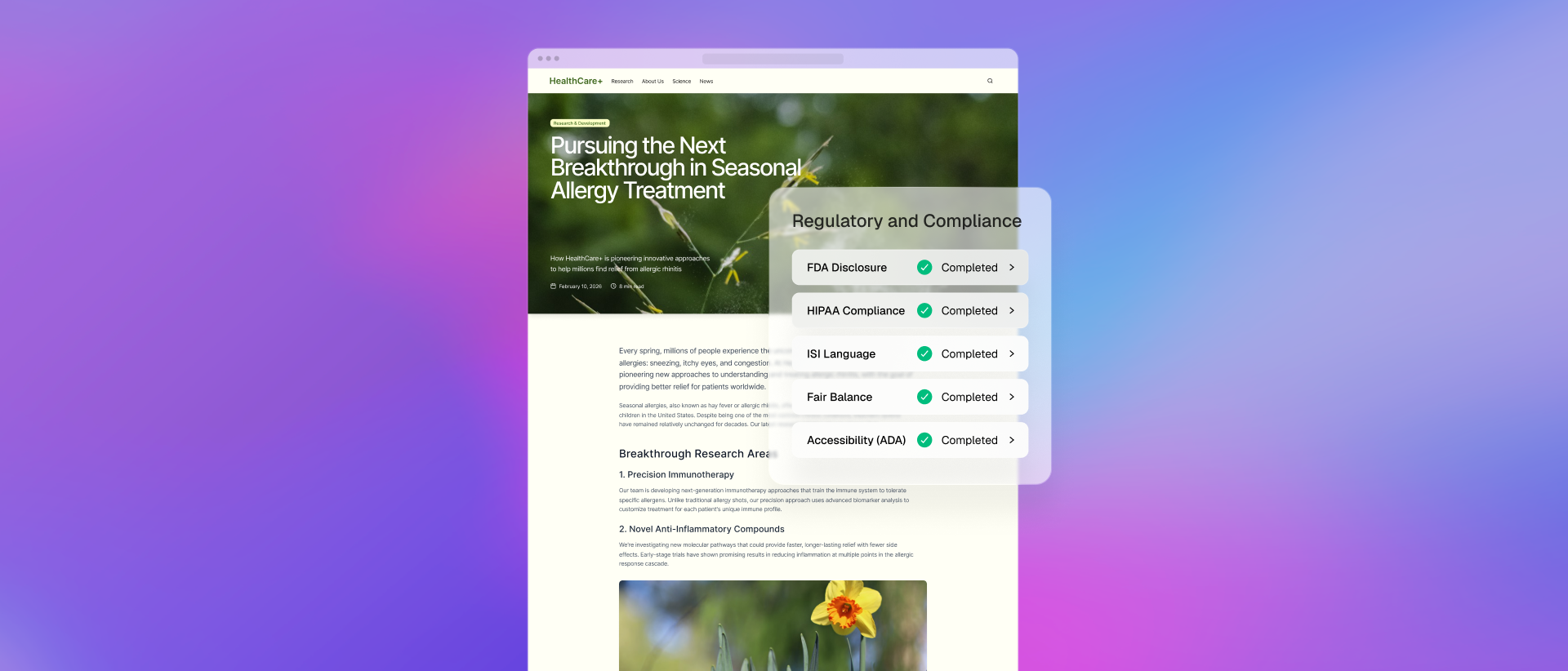
Embed compliance and accessibility. Gradial agents enforce brand language guardrails, WCAG 2.2 accessibility standards, metadata governance, and structural component validation. By flagging issues before publishing, teams reduce MLR friction and minimize the rework cycles that consume launch timelines. Governance runs automatically, 100% of the time, not sampled occasionally.
Scale global localization. Structured translation workflows and integration with language providers enable faster country rollouts, consistent metadata tagging, and regional personalization without duplication. Global brand integrity improves while local flexibility stays intact.
Strengthen DAM and metadata governance. Gradial agents upload and tag assets, apply taxonomy standards, and update metadata at scale. The result is stronger discoverability, improved SEO/AEO readiness, and less operational drift over time.
The business impact
For pharma enterprises invested in AEM, this isn’t a marginal improvement, it’s a structural shift in how content operations work: reduced manual content authoring labor, faster time-to-market for campaigns and launches, fewer MLR rejection cycles, accelerated safety update execution, lower compliance exposure, improved global consistency, stronger accessibility compliance, and faster regulatory approvals.
Enterprise pharma brands using Gradial are seeing 10x faster execution timelines and 35%+ year-one operational savings, while maintaining 100% governance on every output.
Diagnose your own AEM bottleneck
Before your next steering committee, run this exercise:
- Trace one safety update end-to-end. From the moment the decision was made to update ISI language, how many days until every affected page was live? How many people touched it? How many of those touches were value-adding vs. just routing?
- Count your MLR rework loops on the last three submissions. How many rejections were caused by inconsistencies that could have been caught before submission: brand language, metadata, accessibility gaps?
- Pick one global campaign and map the localization timeline. From master content approval to the last market going live, where did the most time accumulate? Was it translation, or was it the manual rebuild in AEM?
- Ask your DAM team: If you needed to find every instance of a specific product image across all markets right now, how long would it take?
If those answers reveal more waiting than working, the constraint isn’t your team or your content management system,. It’s the operational layer between them.
That’s exactly where Gradial sits. Schedule a working session with us to map your current AEM content workflows and identify where agent-driven execution can reduce risk, accelerate launches, and unlock the scale AEM was built for.

Cara Olson
Industry Lead, Healthcare & Life SciencesCara is an industry leader at Gradial, focused on Health and Life Sciences brands. She is partnering with payers, providers, and pharmaceutical, bio, and life sciences companies like Kaiser Permanente, GSK, and Mayo Clinic, to transform their marketing and content operations workflows. She finds it rewarding to give marketers joy back in their jobs by centering their initiatives on patients and providers rather than on tedious tasks to complete website updates.
Get updates from where the work gets done
Sign up to receive product releases, execution insights, and real-world use cases from the Gradial system of work.