
AI Agents for Marketing Teams: The Enterprise Guide to Governed Execution
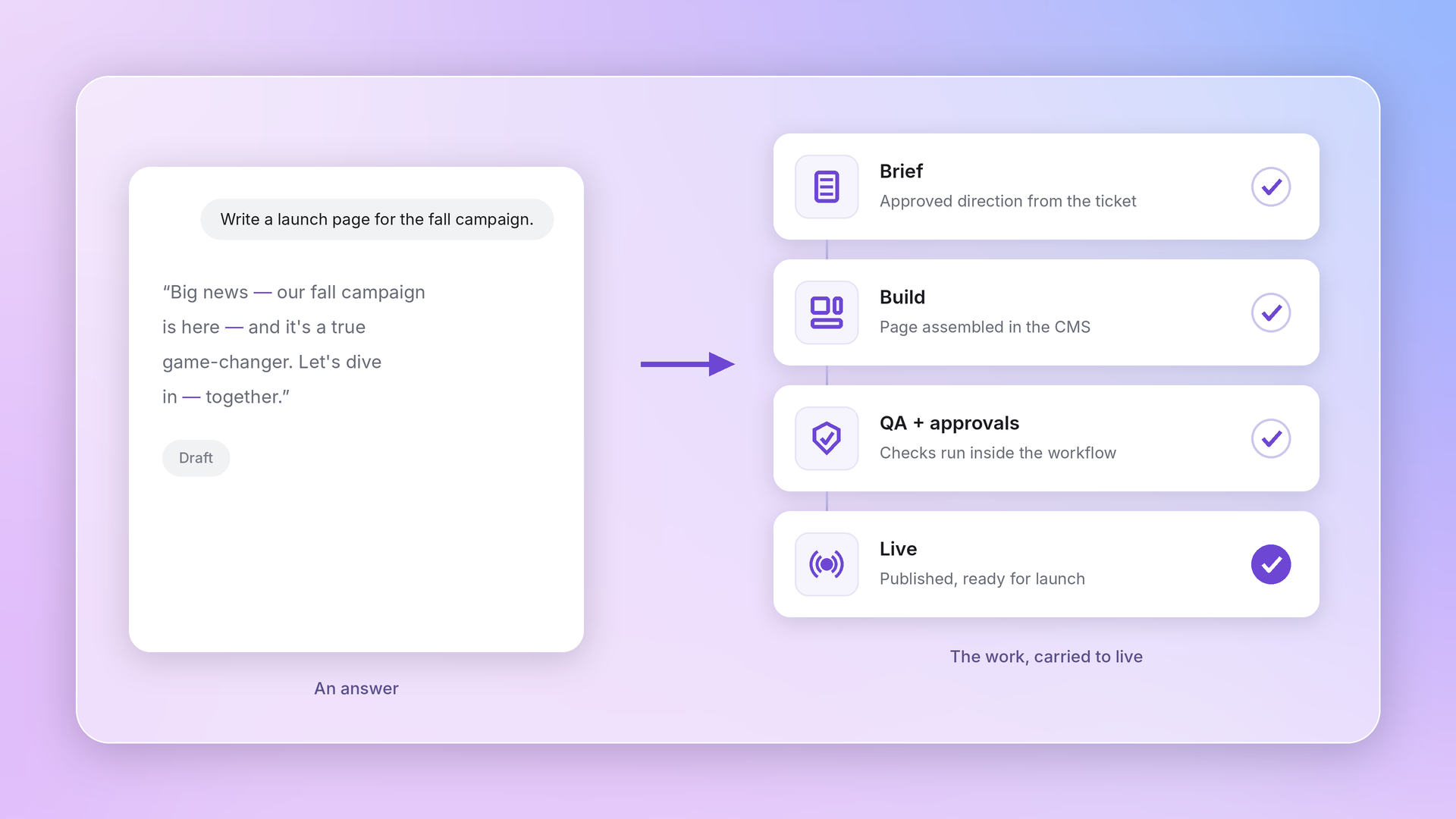
AI agents for marketing teams are software systems that can interpret a goal, plan work, use approved tools and business context, take actions across marketing systems, and return evidence for review. Unlike a chatbot or a content generator, a marketing agent can move a defined workflow forward: prepare a CMS draft, retrieve an approved asset, apply metadata, run brand and accessibility checks, route an approval, or execute an authorized change in the system where the work lives.
That distinction matters in the enterprise. The value of an agent is not the number of outputs it can generate. The value is the amount of governed marketing work it can complete reliably, at an acceptable cost, with the right human decisions preserved.
The market is moving quickly from isolated assistants toward agentic systems. Gartner and Forrester have helped make the enterprise implications visible: agents can pursue goals, use tools, coordinate actions, and change how work is organized. For marketing leaders, the next question is more specific. How do you scale agents without creating a new layer of disconnected tools, unpredictable model spend, inconsistent brand decisions, and unreviewable actions?
This guide explains the operating model, architecture, use cases, governance controls, cost model, measurement framework, and adoption path for enterprise AI agents in marketing. It also explains why adding more agents to the same fragmented process does not create scale. A governed system of work does.
For the broader operating model, read the Agentic Marketing Operations guide.
What is an AI agent for marketing?
An AI agent for marketing is a goal-directed system that can reason over marketing context, choose from approved actions, use connected tools, and complete a bounded part of a workflow. The word bounded is important. Enterprise agents need a defined job, permitted systems, approved sources, risk limits, review rules, and a clear stopping condition.
A useful way to distinguish the categories is by what the system can do:
| Category | Primary behavior | Typical marketing output | What remains manual |
|---|---|---|---|
| Generative AI tool | Creates text, images, or summaries from a prompt | Draft copy or creative concept | Validation, system entry, routing, QA, and publishing |
| Copilot or assistant | Helps a person complete a task in one interface | Recommendation, rewrite, or suggested next step | The person decides and performs most actions |
| Task agent | Completes a defined action using approved tools | CMS draft, metadata update, QA report, or audience build | Cross-system coordination and exception handling |
| Orchestrated agentic system | Coordinates specialized agents, people, tools, policies, and approvals | A review-ready or completed workflow across systems | Strategy, high-risk judgment, exceptions, and final authority where required |
This is why an agent should not be evaluated only on the quality of one answer. Enterprise readiness depends on whether it can act correctly in context, respect permissions, produce evidence, recover from failure, and stop when a human decision is required.
How the market framing is changing
The early marketing AI conversation centered on content generation. The current enterprise conversation is about agency: software that can pursue an outcome, decide which approved step comes next, invoke tools, and coordinate work across a process.
Analyst coverage from Gartner and Forrester increasingly emphasizes four ideas that matter for marketing leaders:
Agents are goal-directed. They work toward an outcome rather than waiting for every instruction.
Agents use tools. Their value comes from acting through enterprise systems, not only producing language.
Agents require orchestration. Multiple agents, models, systems, and people need a shared plan and clear handoffs.
Autonomy requires governance. Access, observability, policy, cost, and human accountability have to scale with action.
Marketing adds another layer to that framing. Agent actions can change public brand experiences, customer communications, consent-sensitive audiences, campaign spend, regulated claims, and content in production systems. The marketing architecture therefore needs more than general AI governance. It needs brand intelligence, content provenance, channel rules, environment awareness, approval evidence, and spend controls embedded in execution.
The practical shift is from asking, “Which tasks can AI help with?” to asking, “Which outcomes can a governed system deliver across the stack, and which decisions must remain with people?”
Enterprise AI-agent decisions are now operational decisions
The first wave of marketing AI experimentation was mostly about individual productivity: summarize this document, draft this email, brainstorm this campaign idea. Those use cases can be helpful, but they do not answer the bigger enterprise question.
For marketing leaders, the question is where agents can safely participate in the operating system of marketing work. Can they help prepare the page update? Can they check whether the asset metadata is complete? Can they assemble a campaign variant from approved inputs? Can they route issues to the right reviewer? Can they show the evidence a human needs before approval?
Those are operational questions. They require workflow design, access controls, review paths, and measurement. They also require a clear line between the work agents can execute and the judgment people should keep.
The strongest enterprise AI-agent programs start there: not with “where can we use AI?” but with “which marketing workflows are repetitive, governed, measurable, and ready for controlled execution?”
Readiness criteria: what makes a marketing AI agent enterprise-ready?
An enterprise-ready marketing agent has to do more than produce a plausible answer. It has to work inside the systems, rules, and review patterns that enterprise marketing teams already depend on.
System access: can the agent work where marketing work happens?
Marketing work moves through workflow systems, copy docs, CMS platforms, DAMs, ESPs, analytics tools, and approval queues. If an agent only produces recommendations outside that stack, the team still has to perform the operational work manually. Each handoff forces an operator to re-enter information, reconcile differences, and absorb the delay, which can make the agent feel like one more tool to manage rather than a source of leverage. When the agent can complete bounded steps where the work lives, teams can move from an approved decision to a review-ready change without rebuilding the work in every system. System access is what turns an agent from an advisory layer into dependable execution capacity while reducing the risk of disconnected, shadow processes.
Context: does it understand brand, workflow, and business rules?
An agent needs more than a prompt because marketing decisions are shaped by brand guidance, product messaging, campaign requirements, legal constraints, taxonomy, page models, content status, and the audience or region the work serves. Without that context, even polished output can violate a rule, use the wrong source, or create exceptions that reviewers must unwind later. The resulting review burden grows as the workflow scales, which erodes trust and pushes teams back toward manual production. When the agent works from the same approved context marketers use, it can make bounded choices consistently and surface only the issues that require judgment. Context therefore determines whether the agent compounds operational knowledge or simply produces more material for people to correct.
Control: can approvals, permissions, and audit trails be enforced?
Enterprise marketing teams should not rely on trust alone because an agent that can act across systems can also move an error across systems. Role-based permissions, defined approval points, environment awareness, and a durable record of changes limit the scope of each action and make responsibility clear. Those controls let teams assign agents specific lanes, such as preparing a draft or applying an approved repair, without granting authority over strategy or final publication. As confidence grows, the lane can expand in a deliberate way while the approval model continues to protect higher-risk decisions. Control is what makes greater execution speed sustainable; without it, every gain in autonomy creates a corresponding increase in operational and reputational risk.
Evidence: can reviewers see what changed and why?
Agentic workflows need reviewable evidence because approval is only useful when a reviewer can understand the basis for the work. The review package should show the source material used, the changes made, the checks completed, and the exceptions that still require human judgment. When that information is missing, reviewers have to reconstruct the agent's process, which lengthens approval cycles and often leads them to redo the work rather than trust it. Clear evidence changes the review from an investigation into a decision, allowing people to focus on risk, quality, and customer impact. If an agent can show its work in the language of the existing review process, it reduces friction; if it cannot, the friction simply moves downstream.
Why adding more agents does not create more scale
It is easy to mistake agent count for agentic maturity. A team can deploy separate agents for copy, SEO, design, analytics, email, CMS work, and campaign planning, then discover that the operating burden has increased.
Context fragments. Each agent receives a different prompt, source set, brand rule, or version of the brief. Outputs may be individually plausible but collectively inconsistent.
Handoffs remain manual. One agent creates a recommendation, another produces an asset, and a person still has to move the work into the DAM, CMS, ESP, project tracker, and approval queue.
Permissions multiply. Every new agent introduces another identity, tool connection, scope decision, and audit surface. Without centralized policy, access becomes difficult to understand and revoke.
Costs become unpredictable. Agents can retry, call other agents, invoke expensive models, or process more context than the work requires. A workflow that looks inexpensive in a demo can become costly at enterprise volume.
Errors compound. If one agent passes an unsupported claim or wrong asset to the next, downstream agents can amplify the mistake with speed and confidence.
No one owns the outcome. Activity logs show that many agents ran, but not whether the campaign is ready, the page is correct, or the work met the business objective.
The answer is not one giant agent. It is an orchestration layer that decomposes the work, selects the right capability, carries shared context, enforces policy, tracks dependencies, controls spend, pauses for review, and verifies the final result. Specialized agents can still do specialized work. They operate as part of one governed system rather than as a collection of disconnected bots.
A reference architecture for enterprise marketing agents
A scalable marketing agent program needs six connected layers. The technology can vary, but the responsibilities should remain clear.
1. Intake and goals
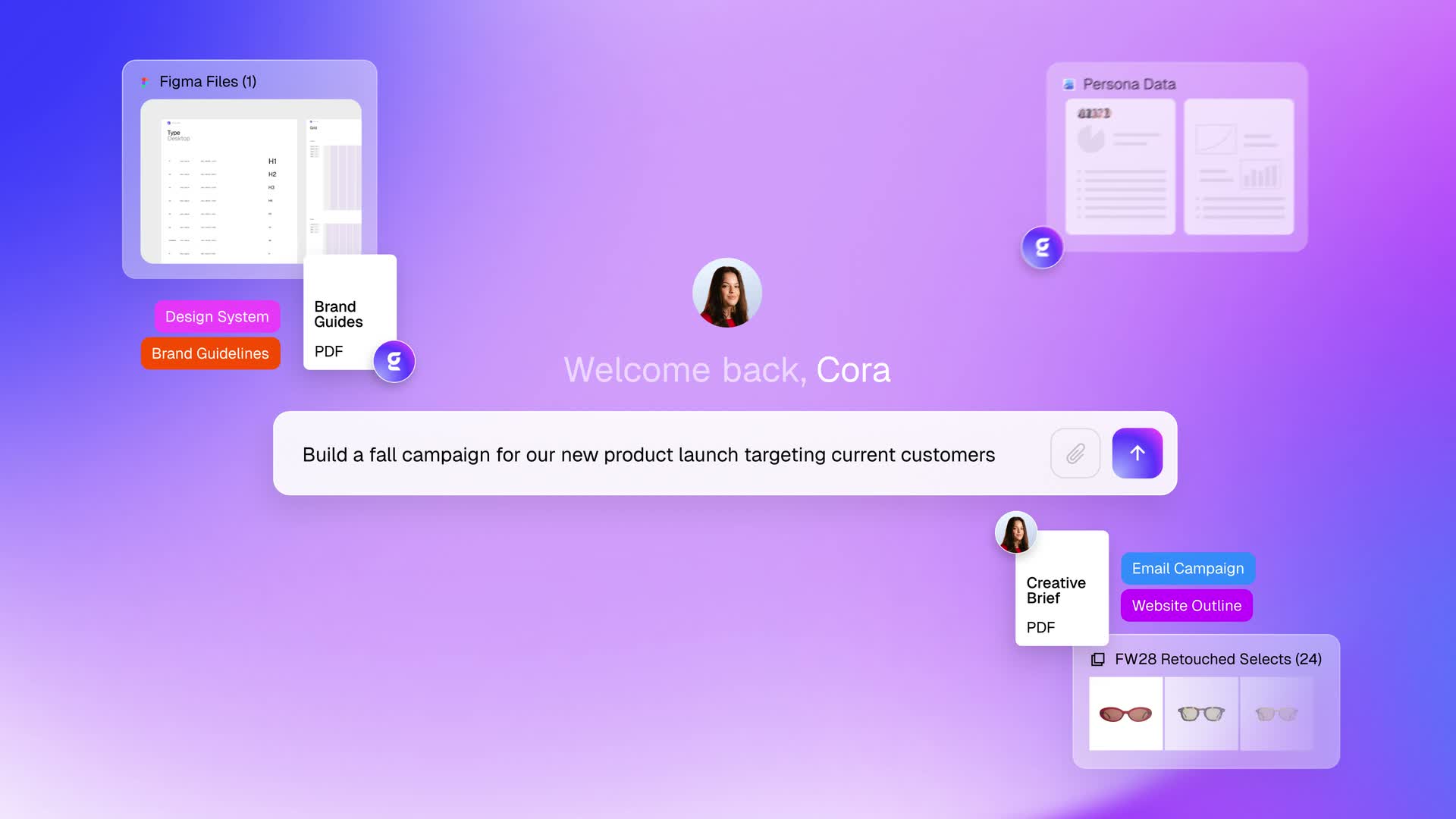
The system needs an authoritative request: the objective, audience, approved brief, required deliverables, target systems, timing, owners, and definition of done. Good intake prevents agents from inventing scope and gives every downstream action a common purpose.
2. Business and brand context
Agents need access to approved brand guidance, product facts, customer evidence, content models, campaign requirements, taxonomy, design patterns, workflow procedures, and market-specific rules. This context should be reusable, versioned, scoped, and attributable. It should not depend on one employee rebuilding the perfect prompt for every run.
3. Orchestration
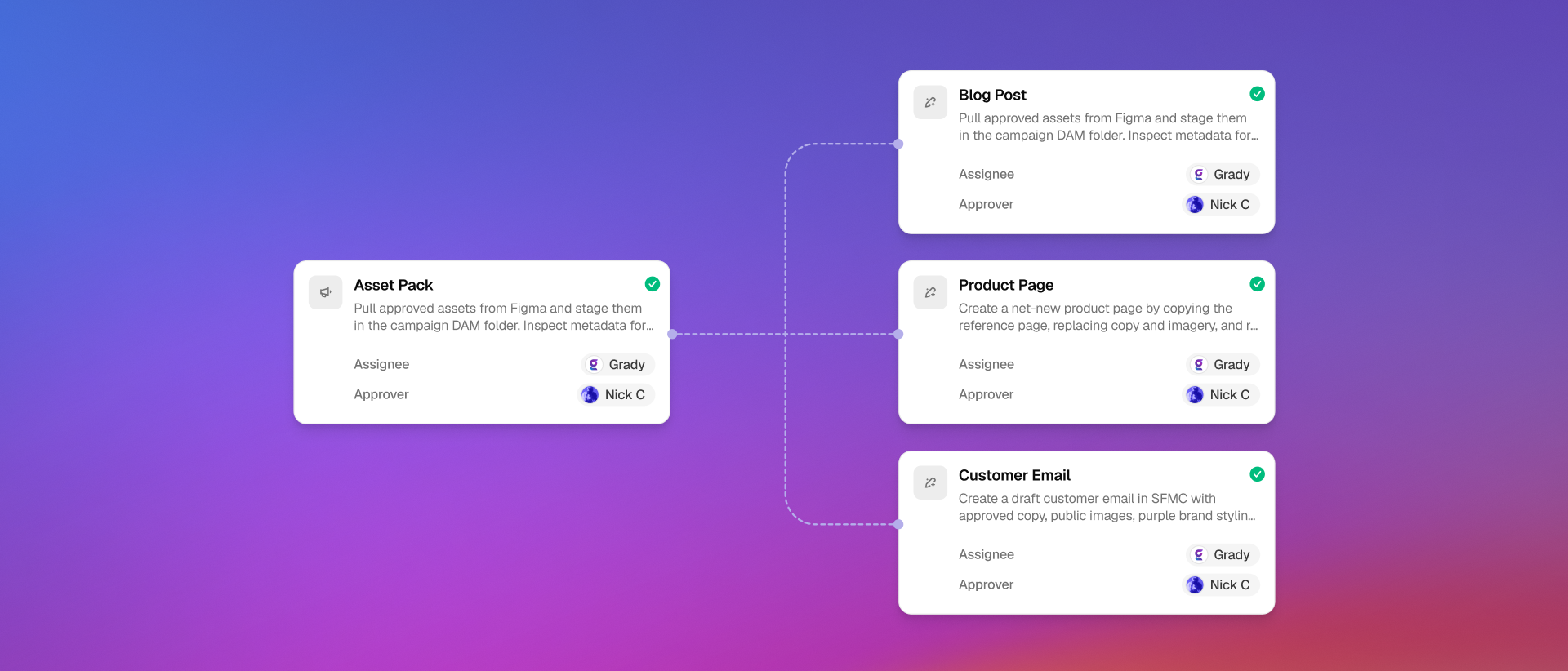
The orchestrator turns the goal into work, assigns the right agent or person, manages dependencies, carries context between steps, and decides when work can run in parallel. It also needs to handle blocked tasks, failed actions, retries, and exceptions without losing the state of the workflow.
4. End-system execution
Agents need governed access to the systems where marketing work happens: CMS, DAM, ESP, CDP, CRM, analytics, design, workflow, ticketing, and collaboration platforms. Native execution removes the copy-and-paste handoff between a recommendation and the system of record. It also makes verification possible because the workflow can inspect the saved or rendered result.
5. Governance and control plane
A central control plane defines identity, permissions, models, tools, policy, approvals, budget, token limits, data boundaries, audit requirements, and escalation paths. This is the command center for understanding which agents are active, what they can do, what they have spent, what they changed, and where a human decision is waiting.
6. Observability and evaluation
Enterprise teams need traces of the plan, sources, tool calls, changes, reviews, model usage, cost, latency, errors, and outcome. Evaluation should test both task quality and workflow quality. A good answer followed by a failed publish is not success. A completed update that violates brand policy is not success. The verified business outcome is the unit that matters.
Use-case prioritization: where should marketing teams start?
Enterprise teams should not start with the flashiest AI-agent idea. They should start with workflows where the value is visible, the rules are knowable, and the review path is clear.
A practical prioritization model can score each candidate workflow across five dimensions:
| Evaluation factor | What to look for | Strong starting signal |
|---|---|---|
| Volume | How often the workflow repeats | Weekly or daily work that consumes operator time |
| Repeatability | How consistent the steps and rules are | A checklist, content model, or standard approval path already exists |
| Risk | What happens if the agent gets it wrong | Errors can be caught in draft or review before reaching customers |
| Review clarity | Whether the human reviewer knows what to approve | Clear owner, clear evidence, clear acceptance criteria |
| Business impact | Whether faster execution matters | Cycle time, rework, launch quality, or freshness affects outcomes |
The best first use cases usually sit in the middle: meaningful enough to matter, structured enough to govern, and not so risky that every action requires bespoke executive judgment.
High-fit enterprise AI-agent use cases for marketing teams
Use case 1: Campaign launch coordination
Campaign launches create operational drag because every step depends on another input, owner, or system, and one missing dependency can stall the rest of the plan. Agents can help prepare task lists, identify missing assets, assemble approved copy, check channel requirements, and keep review packages current as inputs change. That coordination reduces the time operators spend chasing status and gives owners a clearer view of what is actually blocking launch. The use case works best when stages, owners, and launch criteria are already defined, because the agent can then move routine work forward while escalating true exceptions. With those conditions in place, campaign coordination becomes a governed flow instead of a recurring exercise in manual follow-up.
Use case 2: CMS authoring and page updates
CMS work is a strong AI-agent use case because it is often structured, repetitive, and reviewable before publishing. Agents can prepare page drafts from approved copy, populate metadata, check links, apply content model requirements, and generate previews without asking an operator to repeat the same assembly steps. Because the work stays in a draft environment, reviewers can compare the proposed experience with the approved source before any customer sees it. Clear environment separation and human approval for publication keep execution speed from weakening release control. When those safeguards are built into the workflow, CMS agents shorten the path to a review-ready page while preserving the final decision for the accountable owner.
Use case 3: Content QA and brand review
Brand, accessibility, SEO, and compliance checks are strong agent use cases because many requirements can be expressed as rules and applied consistently before a reviewer opens the work. Agents can flag missing metadata, broken links, unsupported claims, tone issues, accessibility gaps, or deviations from approved messaging while the content is still easy to correct. Catching routine defects earlier prevents experts from spending limited review time on issues that should never have reached them. It also gives teams a more consistent quality baseline across pages, channels, and markets, even when production volume rises. The goal is not to replace expert judgment; it is to reserve that judgment for exceptions and higher-order decisions that rules alone cannot resolve.
Use case 4: DAM metadata and asset handoffs
Asset work slows campaigns when metadata is incomplete, rights are unclear, or the correct file is difficult to find at the moment another system needs it. Agents can identify candidate assets, prepare metadata, check required fields, and package approved files for downstream use, which removes repeated searches and preventable handoff gaps. The value increases when DAM work is connected directly to campaign and CMS workflows rather than treated as a separate administrative queue. That connection gives the next step both the asset and the context needed to use it correctly, while exceptions such as unclear rights can still route to a human owner. When metadata and handoffs become part of the governed flow, assets stop being a hidden source of delay and become reliable inputs to execution.
Use case 5: SEO and AI-search operations
SEO and AI-search work increasingly depends on coordinated steps such as structured briefing, internal-link planning, metadata updates, source validation, cannibalization checks, and post-launch monitoring. When those steps live in separate reports or backlogs, valuable findings often expire before a team can turn them into page changes. Agents can connect analysis to bounded execution by preparing reviewed updates, validating requirements, and routing exceptions to the right owner. Measurement still belongs in the loop because teams need to know whether the change improved visibility, engagement, or content quality, but reporting alone does not create that outcome. The operating advantage appears when evidence can move quickly into governed action and the results can inform the next iteration.
Use case 6: Localization and versioning
Localization and audience versioning multiply operational work because every approved message creates new combinations of language, region, format, and review responsibility. Agents can prepare variants from approved inputs, check required fields, apply regional rules, and surface exceptions for local reviewers before inconsistencies spread across channels. This reduces repetitive assembly while keeping local expertise focused on meaning, market nuance, and risk rather than file preparation. The strongest workflows preserve the approved message architecture and make the source-to-variant relationship visible, so reviewers can tell what changed and why. With that foundation, teams can scale governed variation without allowing speed to fragment the brand or weaken local accountability.
Proof in practice
Natixis: Beyond the 3x and 5x execution gains, accessibility work improved too, with image alt-tag audits now running about 2x faster, with fixes happening continuously instead of only during periodic review cycles. Read the full Natixis story.
Governance requirements by workflow risk
Not every AI-agent workflow needs the same level of control. Enterprise teams should match governance to workflow risk.
| Workflow risk level | Example workflows | Required controls |
|---|---|---|
| Low | Summaries, intake checks, issue lists, draft recommendations | Source visibility, reviewer ownership, no direct publishing |
| Medium | CMS draft preparation, metadata updates, QA repairs, asset tagging | Role-based permissions, approval routing, change logs, environment separation |
| High | Regulated claims, legal language, final publishing, customer-sensitive experiences | Mandatory human approval, source validation, audit trail, escalation path |
This risk model helps teams avoid two common mistakes: over-controlling low-risk work until agents cannot create leverage, or under-controlling high-risk work until trust breaks.
Where human review should stay mandatory
Agents should not own the decisions that define the brand, the customer promise, or the risk posture of the business.
Human review should remain mandatory for:
Strategy, positioning, and message architecture
Creative direction and brand judgment
Legal, compliance, and regulated claims
Customer-sensitive or high-risk content
Exceptions that fall outside the approved workflow
Final approval for live customer experiences
A strong agentic operating model does not remove people from the workflow. It gives people better-prepared work, clearer evidence, and fewer manual steps between decision and execution.
Govern brand, access, and agent spend from one command center
Governance needs to operate at the same speed as the agents. A static policy document cannot control a dynamic workflow. Enterprise teams need a command center that turns policy into runtime controls and makes the full agent estate observable.
Brand governance
Approved messaging, terminology, claims, tone, design patterns, accessibility requirements, and market rules should be available as executable context. The system should apply relevant rules before work reaches a reviewer, record which rule was used, and distinguish safe automatic repairs from judgment calls that need escalation.
Identity, permissions, and environments
Each agent needs an identity and the minimum permissions required for its job. Draft authoring, asset metadata, audience creation, campaign activation, and production publishing should not share the same authority. Environment boundaries and approval gates reduce the blast radius when something goes wrong.
Token, model, and tool spend controls
Cost governance should be designed into the workflow. Teams need budgets by organization, workspace, campaign, workflow, or agent; approved model lists; token and invocation limits; routing rules that match model cost to task difficulty; alerts for unusual usage; and clear behavior when a budget threshold is reached. A low-risk classification task should not automatically use the most expensive model available. A workflow should not retry indefinitely because a downstream system is unavailable.
Useful controls include maximum steps per run, maximum retry counts, context-size limits, tool-call limits, per-workflow budgets, model fallback policies, and approval requirements above a cost threshold. The command center should show both unit economics and outcome economics: cost per run, cost per completed deliverable, cost per approved change, and cost relative to cycle time or capacity gained.
Audit evidence and human control
Every consequential action should be attributable. Reviewers need the source, the proposed change, checks completed, unresolved exceptions, model and tool usage, and the identity that approved the next step. Human review should remain mandatory for strategy, regulated claims, sensitive audiences, major budget changes, and final live actions where organizational policy requires it.
How to measure ROI from enterprise AI agents
Enterprise AI-agent ROI should be measured in operational outcomes and unit economics, not vague productivity claims.
| Metric | What it reveals | Example measurement |
|---|---|---|
| Cycle time | Speed from approved input to verified result | Hours from approved copy to review-ready CMS preview |
| Manual handoffs | Coordination burden | Number of people or transfers required per launch |
| First-pass approval rate | Quality of context and execution | Share of outputs approved without preventable rework |
| Defect escape rate | Governance effectiveness | Issues found after launch versus before approval |
| Throughput | Operational capacity | Governed updates completed per week |
| Agent cost per outcome | Economic efficiency | Model and tool spend per approved page, email, or campaign task |
| Human review time | Quality of evidence | Minutes a reviewer needs to reach a decision |
| Content freshness | Ability to respond to change | Time required to update affected experiences after a source change |
Start with a baseline from the manual workflow. Then compare the same unit of work under controlled agentic execution. Include model, tool, infrastructure, implementation, review, and exception-handling costs. The goal is not to minimize token spend in isolation. The goal is to use the least expensive reliable path to a verified business outcome.
Build vs. buy: how to evaluate an enterprise agentic marketing platform
Some organizations will build agent workflows internally. Others will evaluate platforms. Either path should be judged by whether it can support governed marketing execution at scale, not whether it can produce an impressive demo.
Ask vendors and internal teams to demonstrate:
End-system action: Which CMS, DAM, ESP, CDP, CRM, analytics, design, and workflow systems can the agent read and change directly?
Open ecosystem: Can the organization use the models, agents, tools, and integrations that fit each job, or is every workflow locked to one suite?
Reusable enterprise context: How are brand rules, product facts, workflow knowledge, approved sources, and feedback governed and reused?
Orchestration: Can the platform manage dependencies, parallel work, blocked steps, retries, and human assignments across a complete workflow?
Control plane: Can administrators govern permissions, environments, models, tools, token budgets, approval policies, and exceptions centrally?
Evidence and observability: Can reviewers see what changed, why it changed, what was spent, which checks ran, and what remains unresolved?
Verification: Does the system confirm the stored and rendered outcome, or does it stop when an action reports success?
Enterprise operations: Does it support security, auditability, reliability, governance, and deployment patterns appropriate for the organization?
The best proof is a real workflow. Give the platform an approved source, a destination system, governance requirements, a review gate, and a measurable definition of done. Evaluate the completed result, the evidence package, the human effort, the total cost, and the way failure was handled.
A phased roadmap for adopting marketing AI agents
Phase 1: Review and recommend
Start with workflows where agents identify gaps, summarize requirements, flag QA issues, and prepare recommendations because these activities expose how well the system understands the work without giving it execution authority. Teams can compare the agent's findings with known standards, correct missing context, and learn which exceptions require human judgment. That feedback creates an evidence base for improving instructions and governance before the agent begins changing content or systems. It also gives reviewers a low-risk way to build confidence in the quality and consistency of the output. Phase 1 is successful when recommendations are reliable enough to reduce investigation time and make the next decision clearer.
Phase 2: Draft and assemble
Next, let agents prepare review-ready work from approved inputs, such as CMS drafts, metadata updates, content variants, asset packages, or QA repair suggestions. This step matters because it tests whether the agent can translate a correct recommendation into structured work that fits the destination system and the team's standards. Humans still approve before anything goes live, which keeps risk bounded while revealing where source context, templates, or acceptance criteria remain incomplete. As the drafts become more consistent, operators spend less time on assembly and more time evaluating quality and customer impact. Phase 2 creates leverage when the review-ready output is easier to approve than it would have been to produce manually.
Phase 3: Execute bounded workflow steps
Once the team trusts the review pattern, agents can complete defined steps inside controlled systems, such as updating draft fields, checking required elements, preparing previews, routing review packages, or applying approved changes. The scope should remain explicit because bounded authority makes it possible to increase execution speed without creating uncertainty about who owns the outcome. Permissions, change records, and exception paths give reviewers the evidence they need to intervene when the workflow departs from the expected pattern. Successful execution at this stage reduces handoffs and queue time while keeping strategic and high-risk decisions with people. Phase 3 is the point where the program begins to deliver dependable operational capacity rather than isolated assistance.
Phase 4: Orchestrate governed multi-system work
At maturity, agents can coordinate across the workflow, from intake and content preparation through DAM handoff, CMS assembly, QA, approval, and launch support. Orchestration matters because enterprise delays usually accumulate between systems and owners, not within a single production task. When context, permissions, evidence, and review gates travel with the work, the agent can advance each approved step without losing the logic that governed the one before it. People remain responsible for strategy, exceptions, and final customer-impact decisions, while routine execution continues across the stack. Phase 4 turns a set of successful automations into a governed system of work that can scale without recreating the same operational drag in a new form.
How Gradial approaches AI agents for marketing
Gradial is the marketing operations system of work for enterprises. It is built for the operational layer between approved direction and a live customer experience.
Execution in end systems. Gradial agents do the work in the CMS, DAM, ESP, workflow system, copy documents, and other connected tools where marketing already happens. The workflow does not end with a recommendation that someone has to re-enter.
Open agentic ecosystem. Gradial connects people, specialized agents, models, tools, and enterprise systems through one operating layer. Teams can use the right capability for the job without turning the marketing stack into another closed ecosystem.
Agentic content infrastructure. Gradial applies reusable brand, content, workflow, governance, and business context so agents can operate with more of the knowledge a team member would use.
Governed workflows. Permissions, dependencies, review gates, QA, audit evidence, and human approvals stay attached to the work as it moves.
Command-center control. Enterprise leaders need visibility into agent activity, model and tool usage, token spend, workflow status, exceptions, and approvals. Central control makes it possible to expand agentic execution without losing financial or operational accountability.
Verified outcomes. Gradial focuses on work shipped and operational impact delivered. The system checks the final state that marketers and customers will experience, not only whether an agent attempted an action.
This is the difference between deploying more marketing agents and building an enterprise system of work. Agents remain specialized. Context, governance, spend, execution, and accountability become shared.
Frequently asked questions about AI agents for marketing
What are AI agents for marketing?
AI agents for marketing are goal-directed software systems that use approved context and tools to complete marketing work. They can plan steps, act in connected systems, run checks, route approvals, and return evidence. Enterprise agents operate within defined permissions, budgets, and human review rules.
How are marketing agents different from generative AI?
Generative AI creates an output from a prompt. A marketing agent can decide which approved action comes next, use tools, update a system, coordinate with other agents or people, and verify a result. Generation can be one step inside an agentic workflow, but it is not the full workflow.
How can marketing teams use AI agents?
Marketing teams can use AI agents for campaign coordination, CMS authoring, DAM metadata, content QA, brand and accessibility checks, localization, SEO and AI-search operations, email production, audience preparation, reporting, and approval routing. The right starting point has repeatable steps, known rules, measurable value, and a clear review path.
Why do multiple agents need orchestration?
Without orchestration, agents receive inconsistent context, repeat work, create manual handoffs, compete for permissions, and produce costs that are hard to attribute. Orchestration provides one plan, shared context, dependencies, budgets, review gates, and accountability for the final outcome.
How should enterprises control agent token spend?
Set budgets and limits by workflow, campaign, workspace, or agent. Route simple tasks to lower-cost models, cap retries and tool calls, limit unnecessary context, alert on unusual usage, and require approval above defined thresholds. Measure cost per completed and approved outcome, not only cost per model call.
What governance do marketing agents need?
They need scoped identities, least-privilege access, approved models and tools, data boundaries, brand and compliance rules, source provenance, environment separation, human approval points, audit trails, cost controls, exception handling, and a way to stop safely.
Should AI agents publish marketing content autonomously?
Only within an explicit organizational policy and risk model. Most enterprises should keep human approval for live customer experiences, regulated claims, sensitive audiences, major spend, and exceptions. Lower-risk work can become more autonomous after quality, controls, and recovery behavior are proven.
How do you measure marketing agent ROI?
Measure cycle time, throughput, handoffs, first-pass approval, rework, defects, review time, freshness, and total agent cost per verified outcome. Compare against a baseline for the same workflow and include implementation, model, tool, infrastructure, review, and exception costs.
What is the best AI agent for marketing?
The best agent is the one that can complete the specific workflow safely and reliably in your environment. Evaluate system access, context, orchestration, governance, cost control, evidence, verification, and fit with the existing stack. A broad claim of autonomy is less useful than a verified result in a real workflow.
Sources and scope
This guide synthesizes public market framing on agentic AI from analyst firms including Gartner and Forrester, the operational patterns visible across enterprise marketing teams, and Gradial's experience executing governed work across marketing systems. It does not reproduce proprietary analyst research or make unsupported forecasts.
Product and security details are grounded in current Gradial platform, workflow, skills, security, and customer-story pages. The guide focuses on durable operating principles: goal-directed agents, tool use, orchestration, enterprise context, end-system execution, governance, observability, spend control, human accountability, and verified outcomes.
What a first governed deployment should produce
One workflow with a defined input, output, owner, budget, risk level, and review gate.
Fewer manual handoffs between the approved decision and the verified result.
A review package that shows sources, changes, checks, exceptions, and spend.
A measurable before-and-after on cycle time, quality, throughput, and cost per outcome.
A clear decision about which step can gain more autonomy next.
See how Gradial orchestrates governed workflows | Review enterprise security and governance | Assess your first marketing agent workflow