
Agentic Marketing Operations: A Practical Guide for Enterprise Marketing Teams
One T-Mobile campaign that once took 1,000 to 1,200 hours now runs through Gradial in about 80 hours with a QA layer in the loop, a 90% improvement in time to market on the same work.
Enterprise marketing teams are not usually slowed down by the idea. They are slowed down by the operational path between an approved brief and a live experience: the CMS build, the asset tagging, the QA cycle, the compliance review, the approval handoff, and the updates that have to happen across systems that were never designed to move together.
Agentic marketing operations is the shift from using AI only to generate content toward using governed agents to execute the work that surrounds content: coordinating workflows, assembling pages, updating systems, checking quality, routing reviews, and keeping humans in control of the decisions that matter.
Assess your marketing workflow | See how governed agents execute marketing work
What agentic marketing operations means
Agentic marketing operations is an operating model where AI agents can plan, coordinate, and execute defined marketing work across the systems where teams already operate. The goal is not to remove marketers from the process. The goal is to move repetitive operational steps into governed workflows so marketers can spend more time on strategy, craft, customer understanding, and judgment.
In practice, that means agents can help turn an approved brief into a structured set of tasks, assemble or update a page in the CMS, retrieve and tag assets, run brand and accessibility checks, prepare variants, coordinate approvals, and move the work toward launch. Humans still set direction, review sensitive decisions, and own the creative and strategic calls.
Why AI agents are moving from content generation to workflow execution
The first wave of AI marketing focused heavily on generation: drafting copy, creating ideas, or summarizing research. Those tasks can help, but they do not solve the larger operational constraint inside enterprise marketing organizations.
Most teams already know what needs to ship. The hard part is getting it through the systems, reviews, assets, templates, approvals, and quality checks required to make it live. That is why agentic marketing is moving from isolated content creation toward workflow execution. The value comes when agents understand the brand, the work, the systems, and the governance required to move safely from direction to output.
What changes when execution becomes governed
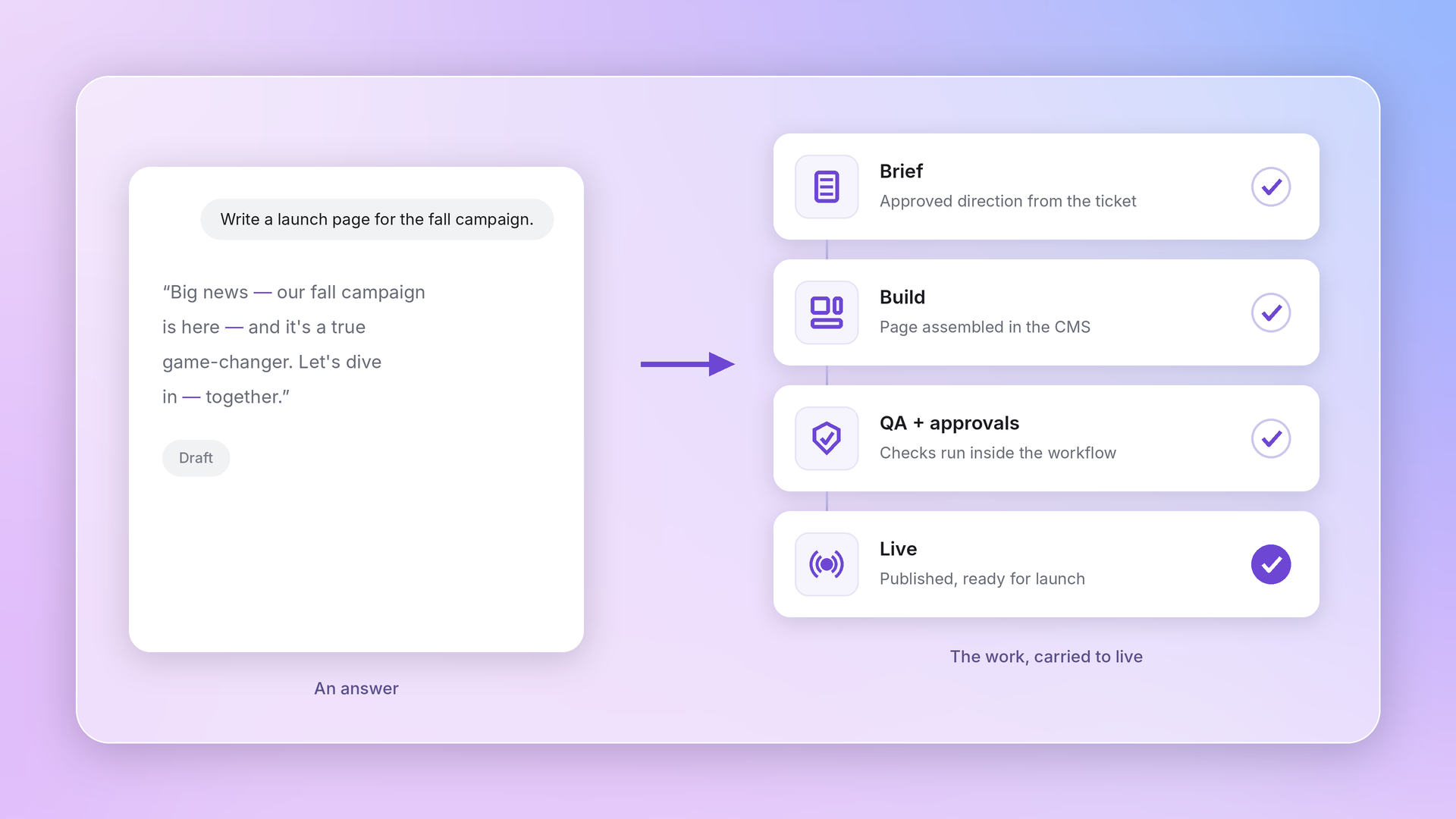
Moving from content generation to governed execution changes specific, observable things about how work moves.
| Before agentic execution | After agentic execution |
|---|---|
| A brief becomes a task list a person assembles by hand | A brief becomes routed work with owners and systems already identified |
| Reviewers see a finished draft and have to ask what changed | Reviewers see the source, the change, and what still needs a decision |
| Brand and compliance checks happen near the end, right before launch | Brand and compliance checks run as part of execution, before the next gate |
| Status lives in someone’s memory until it’s chased down | Status is visible in the systems where the work already sits |
Where agentic marketing operations creates the most leverage
The clearest use cases are the ones with high repetition, high coordination cost, and clear governance requirements. These are the places where enterprise teams lose time without gaining much strategic value.
- Campaign operations: intake, task sequencing, handoffs, approvals, and launch coordination.
- CMS authoring: page builds, updates, migrations, localization, and publishing handoffs.
- Asset operations: retrieval, naming, metadata, alt text, and DAM placement.
- Quality and governance: brand checks, accessibility review, compliance routing, and audit trails.
- Search and content operations: briefs, content refreshes, cannibalization checks, and structured updates across page sets.
For a closer look at campaign execution, see Campaign Workflow Orchestration.
What has to be governed before agents can execute marketing work
Agentic marketing operations only works when governance is part of the workflow. Enterprise teams need controls around who can initiate work, which systems agents can access, what changes require human review, how brand and compliance rules are applied, and how every action is recorded.
The most useful agents do not operate outside the marketing organization. They operate inside its rules. They use approved brand context, follow permission boundaries, respect review gates, and produce artifacts that humans can inspect: copy docs, QA notes, change logs, briefs, and launch summaries.
How to evaluate an agentic marketing operations platform
A platform should be evaluated by the operational work it can safely complete, not by the volume of content it can generate. Useful questions include:
- Can it operate across the CMS, DAM, workflow system, ESP, and other systems where marketing work happens?
- Can it use brand, content, workflow, and governance context?
- Can it route human approvals at the right moments?
- Can it produce reviewable artifacts such as copy docs, QA notes, change logs, and launch summaries?
- Can it improve cycle time, reduce rework, and preserve quality at scale?
This keeps the evaluation grounded in outcomes: more work shipped, fewer manual handoffs, stronger governance coverage, and more time for marketers to focus on the work that needs human judgment.
How Gradial fits into an agentic marketing operating model
Gradial is built for the operational layer between an approved brief and a live experience. Four capabilities carry that work forward:
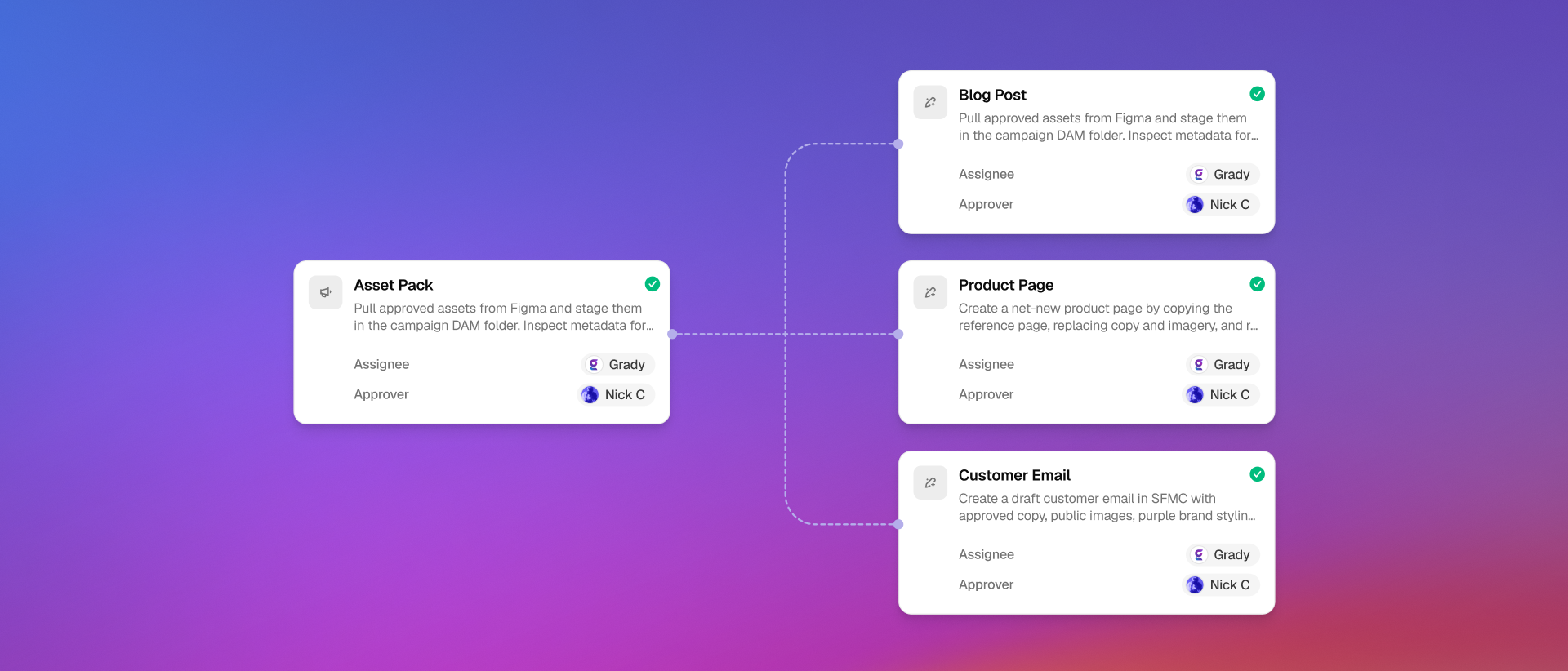
Turns approved direction into routed work. Gradial identifies the systems, owners, and next actions a brief requires, so nothing sits waiting on a person to figure out where it goes next.
Executes inside the existing stack. Gradial agents update the CMS, DAM, and ESP directly rather than handing a person a recommendation to act on themselves.
Keeps governance attached to the work. Brand, accessibility, and compliance checks travel with the task instead of arriving as a final gate.
Shows reviewers what changed. Every action a Gradial agent takes is visible to the accountable owner before it advances.
Proof in practice
T-Mobile: A campaign that previously required 1,000 to 1,200 cumulative hours was completed with Gradial in roughly 80 hours with QA in the loop, and in about 30 minutes for the underlying execution, a 90% improvement in time to market and 10x more throughput.
What changes when agentic marketing operations takes hold
- Approved work moves without waiting on a person to manually route it.
- Reviewers make a decision instead of reconstructing what happened first.
- Governance checks happen inside execution, not as a final gate.
- Marketers spend more of their time on strategy, craft, and judgment.
Assess your workflow | Explore the Gradial platform | See the AI-agent use cases