
AI Content Operations: The Enterprise Guide to Governed Content Execution
Eight operating layers separate a generated asset from content that is approved, structured, localized, published, and measurable. AI can accelerate research and creation, but enterprise value appears only when teams can carry that work through governance, workflow execution, CMS authoring, DAM operations, quality assurance, localization, release, and measurement.
AI content operations is the operating discipline for planning, producing, governing, distributing, and improving content with people and agents working across the enterprise marketing stack. It connects creative direction to controlled execution. The goal is not to generate more content. The goal is to increase the amount of useful, approved, and verified content the organization can deliver within its quality, risk, and cost limits.
This guide defines the category, introduces a five-stage maturity model, and explains the mechanics required to scale AI content operations. For the broader marketing operating model, read the Agentic Marketing Operations guide. For the intake-to-release implementation playbook, read Content Supply Chain Automation. For commercial platform evaluation, use the Content and Campaign Execution solution page.
What is AI content operations?
AI content operations is the coordinated system of people, agents, processes, context, controls, and connected platforms that moves content from an approved need to a verified business outcome. It covers the complete lifecycle, not only the generation step.
| Operating layer | Core question | Required result |
|---|---|---|
| Strategy and intake | What content is needed, for whom, and why? | A scoped request with an owner and definition of done |
| Context and governance | Which sources, rules, and permissions apply? | Approved context, policies, access, and evidence |
| Workflow execution | How does work move across people, agents, and systems? | Tasks, dependencies, approvals, and exception paths |
| Creation and transformation | What must be written, designed, adapted, or assembled? | Structured content ready for its destination |
| CMS and DAM operations | Where does the content live and how is it connected? | Valid entries, pages, assets, metadata, and references |
| Quality and approval | Does the complete experience meet requirements? | Checks, visible proof, exceptions, and decisions |
| Localization and distribution | How does content adapt across markets and channels? | Governed variants with traceable local approval |
| Measurement and learning | Did the content and workflow create value? | Outcome, quality, operational, and cost signals |
Content generation is one task inside content operations
Content generation produces an output. Content operations produces a controlled, reusable, and measurable result. Confusing the two creates volume without capacity.
- Generation drafts: Operations confirms the audience, objective, approved sources, content owner, destination, and acceptance criteria.
- Generation creates: Operations maps the output to content models, components, asset requirements, metadata, and channel constraints.
- Generation varies: Operations manages locale, market, audience, brand, and channel variants without losing source control.
- Generation suggests: Operations executes authorized changes in the CMS, DAM, workflow, design, and campaign systems.
- Generation completes a response: Operations verifies the stored and rendered result, records approval, and measures what changed.
The practical unit of value is not a prompt response. It is an approved content outcome that reached the intended system, audience, or market with evidence attached.
The five-stage AI content operations maturity model
Maturity increases when an organization can move more content through a shared operating system with stronger control and less manual coordination. It does not increase simply because more teams have access to models.
| Stage | Operating pattern | Primary constraint | Next capability to build |
|---|---|---|---|
| 1. Assisted creation | Individuals use AI to research, draft, summarize, or adapt content | Outputs remain disconnected from approved context and end systems | Approved sources, usage rules, review ownership, and reusable prompts or skills |
| 2. Repeatable production | Teams standardize common tasks with templates, checklists, and bounded automations | People still carry context and copy work between tools | Structured intake, shared context, content models, and workflow evidence |
| 3. Governed workflows | Agents and people execute defined sequences with permissions, reviews, and stop conditions | Workflows may optimize one system or team without coordinating the portfolio | Cross-system orchestration, CMS and DAM execution, exception routing, and cost controls |
| 4. Connected content operations | Work moves across CMS, DAM, design, workflow, localization, analytics, and campaign systems | Scale increases the need for portfolio decisions and consistent measurement | Shared taxonomy, localization architecture, quality signals, and outcome economics |
| 5. Adaptive operating system | Content operations learns from performance, quality, cost, feedback, and exceptions | Autonomy must remain bounded by business risk and human accountability | Continuous evaluation, policy-driven autonomy, portfolio optimization, and recoverable execution |
Most enterprises will operate at different stages across workflows. A mature localization process can coexist with an assisted CMS process. Assess maturity by workflow, then connect the workflows through shared context and governance.
How to assess your current maturity
Use evidence from one real workflow rather than a broad AI readiness score. Choose a recurring content outcome, such as a product page update, campaign launch, regional adaptation, or SEO refresh, then trace it from request to verified result.
- Intake clarity: Can the team name the objective, source, audience, owner, risk, destination, and definition of done before production begins?
- Context quality: Are product facts, brand rules, legal guidance, designs, assets, and prior decisions current, approved, and reusable?
- Execution depth: Does AI stop at a draft, or can authorized agents complete structured work in destination systems?
- Control strength: Are permissions, budgets, approvals, exceptions, release authority, and recovery explicit?
- Evidence: Can a reviewer see sources, actions, changes, checks, failures, retries, and unresolved issues?
- Measurement: Can the organization compare quality, cycle time, rework, cost, and business outcome for the same unit of work?
The lowest reliable control point usually determines the workflow's maturity. Strong generation with weak source control remains Stage 1. Connected systems with no approval or recovery model do not qualify as Stage 4.
Governance must travel with the work
Governance is not a final review added after agents create content. It is the operating context that shapes what they can see, decide, change, and advance at every step.
- Source governance: Define approved product facts, customer proof, legal language, research, designs, and content versions. Stop when sources conflict.
- Brand governance: Apply voice, terminology, visual, accessibility, and channel rules during planning and production.
- Identity and access: Separate read, draft, edit, approve, release, and publish authority by system, environment, and content scope.
- Model and tool policy: Choose approved models and tools by task, data boundary, quality requirement, latency, and cost.
- Human accountability: Name the owner and approver for consequential claims, customer-visible experiences, regulated content, and live actions.
- Observability and recovery: Record decisions and changes, define stop conditions, preserve partial work, and support targeted repair or rollback.
Good governance creates safe speed because the workflow knows which actions can proceed, which require evidence, and which require a person to decide.
Workflow execution: move context, evidence, and decisions together
An executable content workflow connects the request, the work, and the result. Each step should name the trigger, owner, system, evidence, exit condition, and exception path.
| Workflow moment | Mechanism | Evidence before advancing |
|---|---|---|
| Intake and triage | A request is classified by content type, audience, system, risk, owner, and due date | Approved source package and definition of done |
| Planning | The workflow maps tasks, dependencies, variants, systems, reviews, and budgets | Execution plan with explicit in-scope and protected areas |
| Production | People and specialist agents create, transform, assemble, and connect content | Structured outputs with provenance and destination references |
| Quality and approval | Stable checks run automatically, safe issues are repaired, and exceptions route to owners | Review package, rendered proof, findings, and recorded decision |
| Release and distribution | Only the approved scope advances through environment and channel controls | Release record, selected content set, and recovery path |
| Measurement and learning | Performance, quality, workflow, and cost data return to the operating context | Result compared with baseline and a named next action |
Parallel work is useful when tasks are independent, such as asset preparation and metadata drafting. Sequential gates are necessary when one decision changes the next action, such as legal approval before localization or rendered validation before release.
CMS operations: turn approved content into structured experiences
The CMS is where content becomes a customer-visible experience. AI content operations must understand the content model and execute against supported templates, components, fields, references, locales, routes, metadata, and environments.
- Model before writing: Resolve the page family, schema, template, components, and field constraints before mapping copy.
- Reuse approved patterns: Prefer existing components and layouts. Escalate model gaps instead of inventing unsupported structure.
- Preserve portfolio signals: Protect routes, canonicals, redirects, internal links, navigation, taxonomy, and search-intent ownership.
- Separate environments: Keep drafting, approval, release selection, and publication as distinct actions.
- Verify the render: Confirm the full page experience, not only the saved fields or successful system action.
For deeper content-model, page-assembly, and release mechanics, read the CMS Authoring Guide.
DAM operations: make assets usable, governed, and traceable
A DAM is not only a file library. It is the control system for asset identity, rights, metadata, renditions, relationships, approvals, and reuse. AI content workflows should treat asset operations as a first-class part of execution.
- Find the approved source: Search by campaign, product, audience, market, rights, status, and taxonomy rather than filename alone.
- Validate fitness: Check dimensions, aspect ratio, focal point, format, performance, accessibility needs, and destination constraints.
- Preserve rights: Respect license, geography, channel, talent, expiry, and usage restrictions before placement or transformation.
- Create governed renditions: Crop, resize, compress, or localize from the approved master while preserving lineage.
- Write useful metadata: Add descriptive titles, alt text, taxonomy, campaign links, products, markets, and content relationships.
- Link rather than duplicate: Maintain valid asset references between the DAM and CMS so updates remain traceable.
Completion means the correct asset renders in the intended experience with the right metadata and usage authority. A generated image or downloaded file is only an input.
Quality assurance: test the complete content outcome
AI increases production capacity only when quality controls increase with it. The workflow should run deterministic checks early, use judgment-based review where context matters, and attach evidence to every exception.
| Quality layer | What to check | Proof of readiness |
|---|---|---|
| Factual | Claims, dates, product facts, customer proof, source freshness, and attribution | Traceable sources and resolved conflicts |
| Brand | Voice, terminology, visual system, imagery, and channel conventions | Rules applied and exceptions reviewed |
| Accessibility | Headings, labels, links, alt text, tables, contrast, focus, and media alternatives | Checks plus human review of experience-critical paths |
| Technical | References, links, routes, rendering, responsive behavior, media performance, and integrations | Stored-state and rendered validation |
| Search and discovery | Intent, metadata, canonical, internal links, indexability, structured content, and AI-answer readability | Clear ownership and durable discovery path |
| Governance | Permissions, required approvals, policy scope, release authority, and audit evidence | Recorded decision and bounded release scope |
A quality score without evidence is difficult to act on. Reviewers need to see what passed, what was repaired, what remains unresolved, and who can accept the remaining risk.
Localization: scale meaning, not only language
Localization is a governed transformation of an approved source into a market-ready experience. Translation is one step. The workflow must also preserve meaning, brand, legal requirements, product availability, cultural context, layout, metadata, assets, links, and local approval.
- Freeze the source: Identify the approved source version, reusable fields, protected text, and change owner.
- Classify variation: Separate direct translation from transcreation, legal adaptation, product or offer changes, local SEO, and market-specific assets.
- Carry context: Attach terminology, style, audience, market, product, legal, design, and prior feedback to each locale task.
- Execute in structure: Create locale variants in the CMS and DAM without breaking references, inheritance, components, or route rules.
- Run local QA: Check truncation, directionality, character support, links, metadata, assets, disclaimers, and rendered layout.
- Route local approval: Send exceptions to the accountable regional, brand, legal, or product owner.
- Manage source changes: Propagate only the approved delta and show which locales require rework.
Measure localization by approved market-ready outcomes, not raw word count. A fast translation that creates review debt or broken experiences is not efficient content operations.
Measurement: optimize for verified content outcomes
AI content operations should improve four layers at once: audience outcome, content quality, operating performance, and economics. A single speed metric can reward low-quality volume.
| Measurement layer | Signals | Decision it supports |
|---|---|---|
| Audience and business | Engagement, task completion, conversion, retention, search visibility, and customer feedback | Did the content help the intended audience and business goal? |
| Content quality | First-pass approval, factual corrections, brand exceptions, accessibility defects, broken links, and stale content | Did the workflow preserve trust and usefulness? |
| Operations | Cycle time, backlog age, handoffs, review time, rework, throughput, release frequency, and exception rate | Did the operating system create reliable capacity? |
| Economics | Model, tool, infrastructure, agency, and human-review cost per approved outcome | Did the workflow create efficient capacity? |
| Governance | Policy violations, permission exceptions, unresolved findings, recovery events, and audit completeness | Is autonomy expanding within acceptable risk? |
Set the baseline, observation window, and unit of work before execution. Compare like with like, such as one approved page, localized variant, campaign update, asset package, or resolved defect. Use the result to change the workflow, not only to report activity.
A reference architecture for AI content operations
A durable architecture separates shared context and governance from system-specific execution. That lets the organization change a model, agent, CMS, DAM, or workflow tool without rebuilding the operating model.
- Demand layer: Audience needs, business goals, campaign plans, search signals, content performance, and recurring operational events.
- Intake layer: Briefs, tickets, designs, copy documents, spreadsheets, conversations, and system triggers.
- Context layer: Brand, product facts, customer proof, content models, taxonomy, audience, market, policy, history, and feedback.
- Orchestration layer: Scope, tasks, dependencies, routing, people, agents, approvals, budgets, stop conditions, and evidence.
- Execution layer: Creation, transformation, CMS authoring, DAM operations, localization, QA, campaign assembly, and distribution.
- Governance layer: Identity, permissions, models, tools, environments, policy, spend, observability, and recovery.
- Measurement layer: Audience outcome, discovery, quality, workflow performance, cost, and learning.
The architecture should be open and additive. It should connect the systems where marketing already happens while preserving one shared view of the request, context, action, evidence, and outcome.
How Gradial supports AI content operations
Gradial is the marketing operations system of work for enterprises. Gradial agents execute operational work across connected marketing systems while shared workflows carry context, governance, evidence, and human decisions from request to verified result.
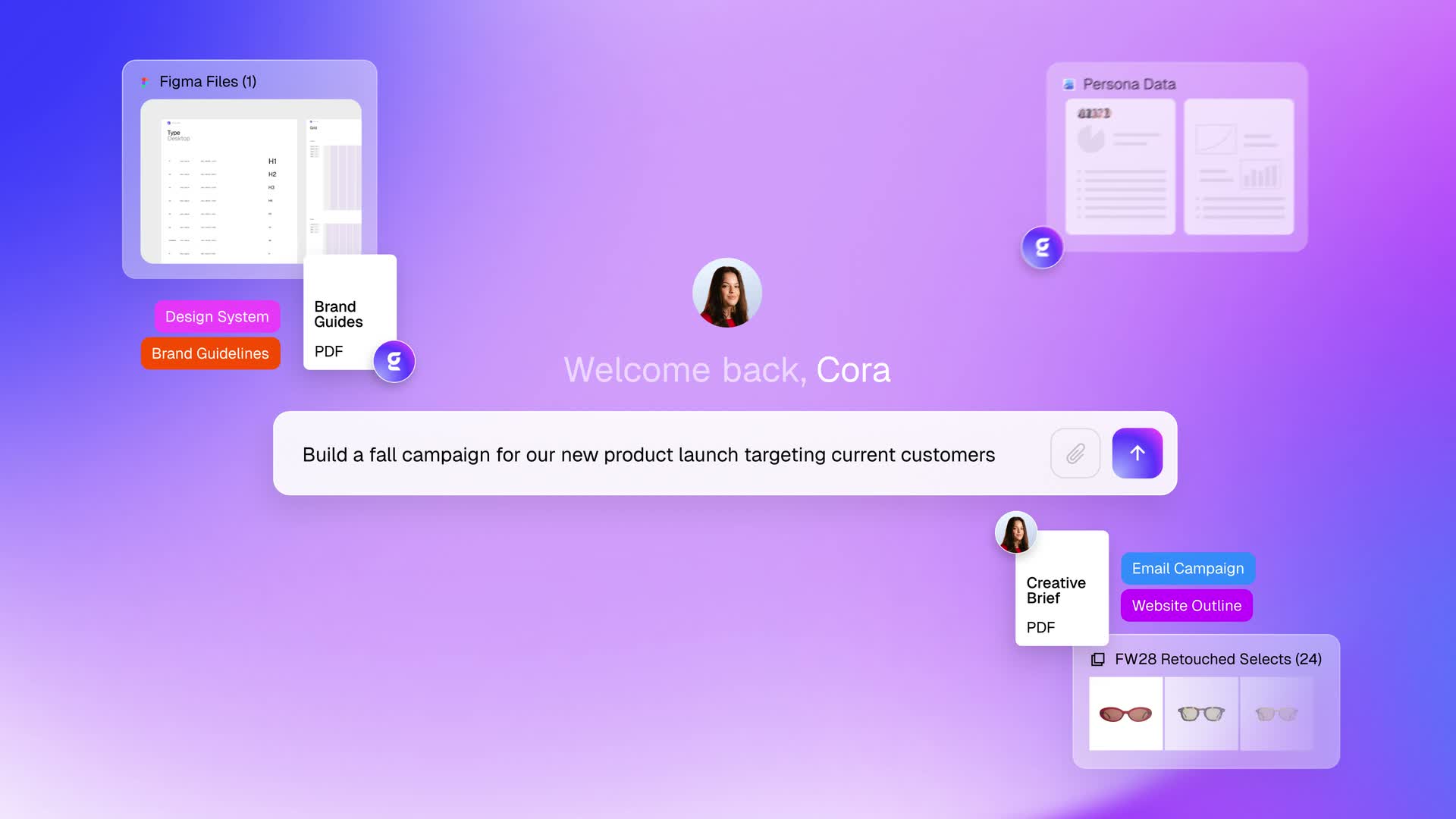
- Context-aware intake: Gradial can turn briefs, copy documents, designs, tickets, and plans into scoped work with owners, dependencies, and acceptance criteria.
- Reusable operating context: Gradial Skills encode brand guidance, content models, workflow rules, review logic, and learned practices so teams do not rebuild instructions for every task.
- Cross-system execution: Gradial agents can prepare and apply authorized work across connected CMS, DAM, design, workflow, analytics, collaboration, and campaign systems.
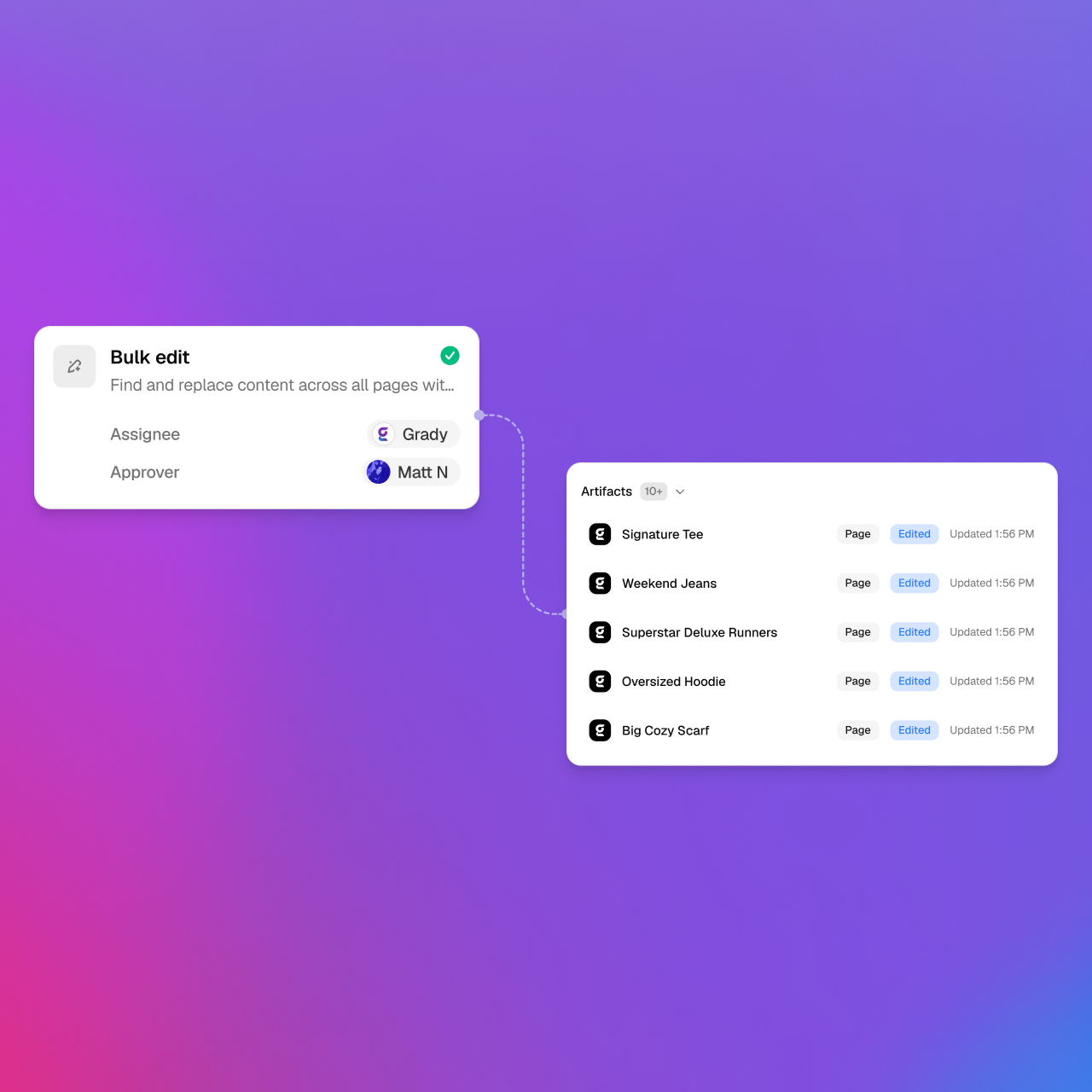
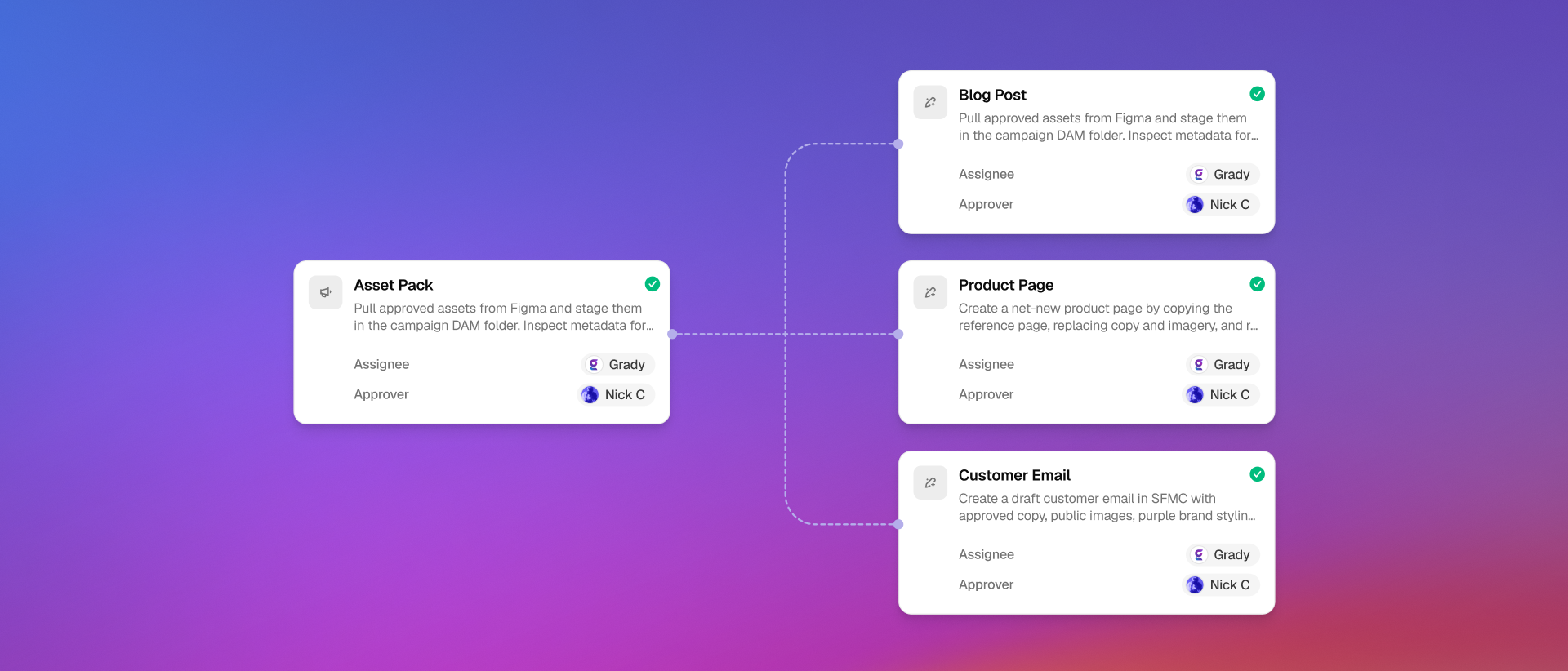
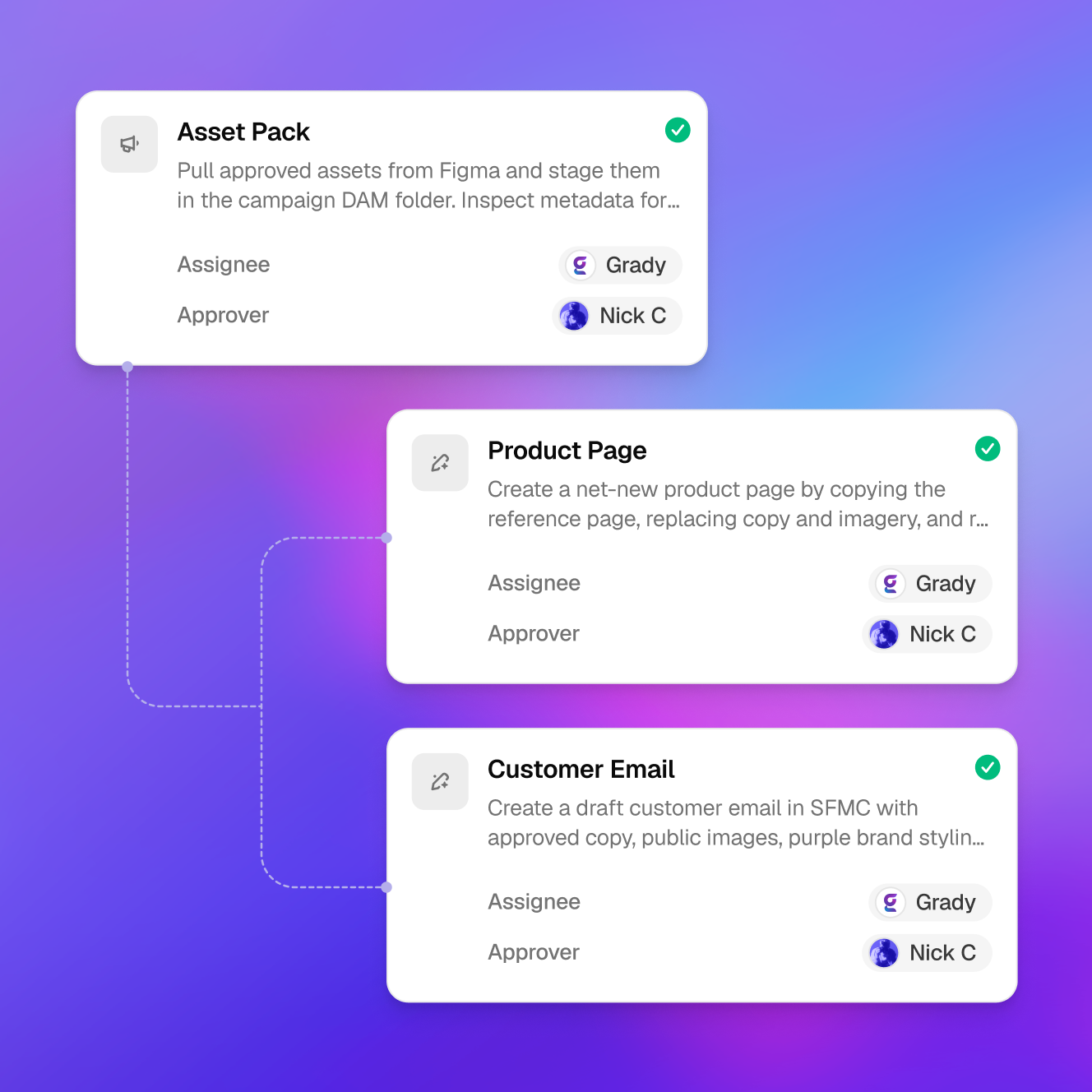
- Governed orchestration: Gradial Workflows connect dependent and parallel work, people, agents, systems, evidence, and approval points.
- Visible verification: Gradial checks the changed resource and, when a rendered experience exists, the customer-visible result before treating work as complete.
- Operational learning: Repeatable workflows can preserve corrections, exceptions, approvals, and outcomes as reusable context for future work.
The product question is not whether an AI model can create a draft. It is whether the operating system can move approved direction through the real stack with the controls and evidence the enterprise requires.
A five-step roadmap for adoption
1. Choose one recurring content outcome
Select work with clear demand, repeatable structure, accessible systems, and an accountable owner. Map the current sources, steps, handoffs, controls, exceptions, time, quality, and cost.
2. Standardize context and intake
Define approved sources, content types, owners, destinations, protected areas, risk levels, and visible definitions of done. Build reusable brand, product, content-model, and workflow context.
3. Connect draft execution
Grant scoped access for agents to create structured drafts, prepare assets, apply metadata, and run stable checks in non-live environments. Keep consequential changes and release authority behind human approval.
4. Orchestrate the lifecycle
Connect CMS, DAM, design, workflow, localization, analytics, and campaign systems. Carry evidence and decisions across steps instead of rebuilding context at every handoff.
5. Expand autonomy with evidence
Increase scope only after the workflow proves quality, recovery, cost, and owner trust. Expand by content type, market, channel, or risk tier while keeping explicit stop conditions and measurement.
Frequently asked questions about AI content operations
What is AI content operations?
AI content operations is the operating discipline for planning, producing, governing, distributing, and improving content with people and agents working across connected enterprise systems. It covers the full lifecycle from intake and approved context through CMS, DAM, QA, localization, release, and measurement.
How is AI content operations different from content generation?
Content generation creates copy, images, summaries, or variants. AI content operations turns approved inputs into structured, governed, reviewable, and measurable outcomes in destination systems. Generation is one task inside the operating lifecycle.
What are the stages of AI content operations maturity?
The five stages are assisted creation, repeatable production, governed workflows, connected content operations, and an adaptive operating system. Organizations should assess maturity by workflow because different content processes often mature at different rates.
Which systems are part of AI content operations?
Common systems include the CMS, DAM, design platform, workflow or ticketing system, translation technology, collaboration tools, analytics, search data, campaign platforms, and the models or agents that perform bounded tasks across them.
How should enterprises govern AI content workflows?
Attach approved sources, brand rules, permissions, model and tool policy, budgets, human ownership, approval requirements, stop conditions, evidence, and recovery to the workflow. Separate draft authority from approval, release, and publication authority.
Where does localization fit?
Localization is a governed transformation of an approved source into market-ready content. It includes translation, terminology, legal adaptation, product and offer differences, local SEO, market assets, CMS structure, QA, and local approval.
How should teams measure AI content operations?
Measure audience and business outcomes, content quality, operational performance, economics, and governance together. Use a consistent unit such as one approved page, localized variant, campaign update, asset package, or resolved defect.
Where should teams evaluate AI content operations platforms?
Use the Content and Campaign Execution solution page for commercial evaluation and platform-specific next steps. This guide stays focused on category definition, maturity, and operating mechanics.
What a mature AI content operation produces
- A shared definition of AI content operations with maturity assessed by real workflow, not model access.
- Approved context, governance, permissions, budgets, and human accountability attached to execution.
- Connected workflows that carry content through CMS, DAM, QA, localization, release, and measurement.
- Evidence for every consequential action, exception, approval, and customer-visible result.
- A measurement loop that improves audience outcome, content quality, operating performance, and cost per verified outcome.
- Go deeper on CMS execution: Learn the mechanics of structured authoring, assets, approvals, release, and rendered verification.
- Connect content operations to AI search: See how GEO and AEO evidence becomes governed content and technical work.
- Evaluate content and campaign execution: Explore the commercial solution and map the first workflow to your stack.