
AI Search Operations: The Enterprise Guide to GEO and AEO Execution
Across four Gradial studies covering thousands of organizations and millions of AI searches, the same operating gap appeared again and again: brands were often mentioned far more often than their owned websites were cited. The problem was not simply visibility. Third-party sources were defining the evidence layer, technically blocked pages were invisible to crawlers, broad marketing pages were difficult to quote, and obvious fixes still had to compete for CMS, engineering, legal, and content capacity.
That is the central challenge of generative engine optimization (GEO), answer engine optimization (AEO), and AI search operations. Measurement can reveal where a brand is absent, misrepresented, or outranked. It does not change the answer. Improvement happens only when the organization turns that evidence into approved changes across content, technical infrastructure, structured data, digital assets, third-party sources, and the systems that govern publication.
This guide gives enterprise marketing teams a practical operating model for doing that continuously. It focuses on the work after the dashboard: deciding which gap matters, choosing the right intervention, executing it in the right system, protecting brand and budget, and measuring whether the answer changed.
For the shared foundation across traditional search and AI search, read the AI SEO Operations guide. This guide goes deeper on the distinct operating mechanics of AI-generated answers, citations, source ecosystems, prompt portfolios, and visibility-to-action workflows.
What are AI search operations?
AI search operations is the governed discipline that turns observations from AI answer engines into prioritized, executed, and measured changes across an enterprise's content and technology estate.
In plain language, it answers six questions:
- What are customers asking AI systems in the moments that matter?
- How is the organization, product, category, or issue represented in the answer?
- Which owned or third-party sources appear to shape that representation?
- What specific gap explains the current result?
- Which change can the organization credibly make, in which system, under which controls?
- Did the approved change improve coverage, accuracy, citations, influence, or customer outcomes?
GEO and AEO describe the optimization objective. AI search operations describes the operating system that makes optimization repeatable. It connects research, content strategy, digital operations, technical SEO, communications, analytics, governance, and agent execution instead of leaving each function with a separate report.
GEO, AEO, and AI search operations: how the terms fit together
| Term | Primary focus | Useful enterprise interpretation |
|---|---|---|
| SEO | Discoverability and performance in search engines | Build crawlable, useful, authoritative experiences that satisfy search intent and support business outcomes. |
| GEO | Visibility and representation in generative answers | Improve whether and how a brand, product, or topic appears in AI-generated responses, including the sources cited. |
| AEO | Becoming a clear, trustworthy answer | Structure facts, explanations, entities, and evidence so answer systems can understand, extract, and attribute them. |
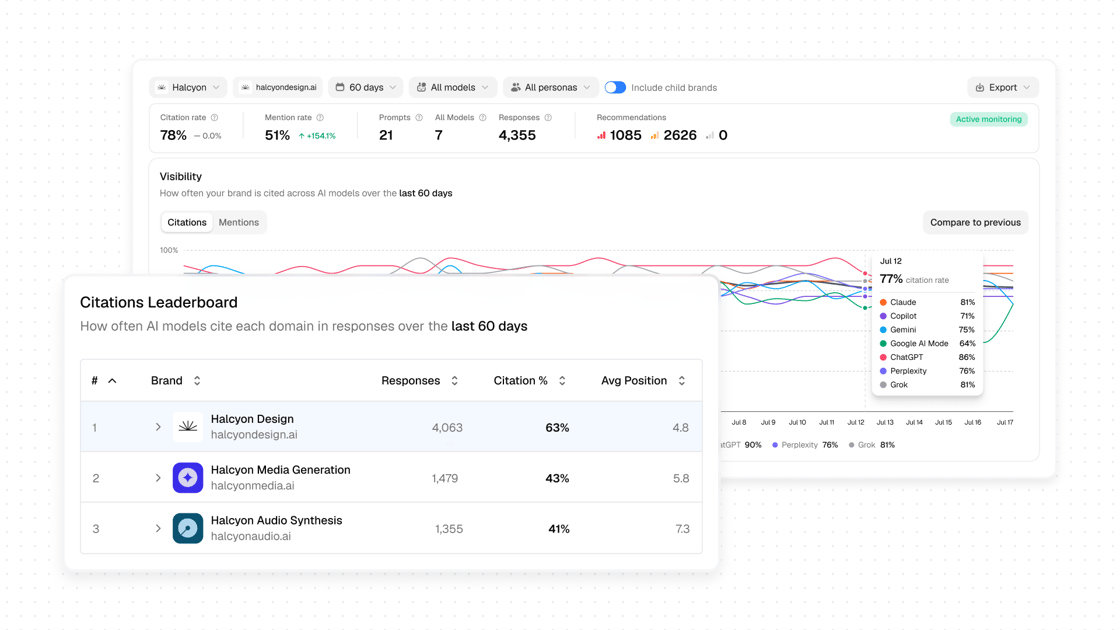
| AI search visibility | Observed presence across prompts and providers | Measure mentions, citations, position, accuracy, sentiment, competitors, and source behavior across a defined prompt portfolio. |
| AI search operations | The system that turns evidence into action | Prioritize, execute, govern, verify, and learn across people, agents, workflows, and end systems. |
Teams do not need separate organizations for every term. They need one operating model that preserves the shared search foundation while accounting for the different evidence, source behavior, volatility, and measurement patterns of AI answers.
Visibility is a signal, not the outcome
AI search dashboards can create the same failure mode that enterprise marketing has seen with other analytics platforms: the organization becomes better at seeing the problem than fixing it.
- Observation without ownership: A gap is detected, but no page, source, team, or system owns the response.
- Recommendation without specificity: “Create more authoritative content” does not identify the claim, audience question, page, component, source, reviewer, or acceptance test.
- Content without authority: A draft repeats what is already known but adds no primary evidence, expert contribution, comparison, or clear answer.
- Authority without access: The strongest page is blocked, rendered only after client-side scripts run, canonicalized incorrectly, or buried without internal links.
- Change without verification: A team publishes an update but never repeats the same prompts, checks the cited sources, or confirms that the live page is visible to the relevant crawlers.
- Activity without economics: Agents run more prompts and generate more revisions, but cost per approved improvement is unknown.
The operating objective is not “more AI search activity.” It is a verified improvement in how priority audiences discover and understand the organization, achieved through a controlled amount of work and spend.
What current enterprise AI search research reveals
Gradial's recent industry studies show why enterprise teams need a gap-based operating model rather than one generic GEO checklist.
| Study | Observed pattern | Operational implication |
|---|---|---|
| 28 retail and consumer brands | 44% average mention rate and 8% average owned-domain citation rate across more than 1,600 searches | Brand awareness does not automatically create owned-source authority. Informational and comparison content often matters more than promotional product pages. |
| 51 colleges and universities | 35% average mention rate and 10.5% average owned-domain citation rate across more than 7,000 data points | Specific programs, policies, outcomes, financial-aid facts, and geographic authority can outperform broad institutional prestige. |
| 55 travel and hospitality brands | 43.3% average mention rate and 15.8% average owned-domain citation rate across more than 7,700 data points | Crawler access, canonical accuracy, server-rendered critical content, and narrow category authority can determine whether a brand earns attribution. |
| 20+ global airlines | 71% average mention rate and 9.9% average owned-domain citation rate across more than 1,260 searches | Brands can be highly visible while third-party publishers own the citation layer for loyalty, premium products, and comparison questions. |
These studies are directional, not universal benchmarks. Query sets, providers, industries, dates, and methodologies differ. The durable lesson is that the gap must be diagnosed before it is treated. A technical access failure, an authority gap, an inaccurate answer, and a missing comparison page require different work.
The eight AI search gaps enterprise teams need to diagnose
| Gap | What it looks like | Likely intervention |
|---|---|---|
| Coverage | The brand or offer is absent for a relevant prompt set | Create or strengthen a credible source that directly satisfies the underlying question. |
| Accuracy | The answer contains an outdated, incomplete, or incorrect fact | Correct the authoritative source, clarify the entity and claim, add dates and evidence, then address influential third-party sources where appropriate. |
| Citation | The brand is mentioned, but owned pages are rarely cited | Improve answer specificity, extractability, evidence, canonical clarity, and the page's role as a reference source. |
| Access | Crawlers cannot reliably retrieve the critical content | Review robots controls, crawler policy, authentication, rate limits, server responses, and rendering dependencies. |
| Extractability | The answer exists on the page, but it is buried, vague, image-based, or dependent on interaction | Use direct headings, concise answer blocks, tables, lists, visible text, and accurate structured data. |
| Authority | Third-party sources provide stronger evidence or clearer expertise | Add primary data, expert review, methodology, proof, citations, authorship, and topic-specific depth. |
| Freshness | AI systems repeat old product, pricing, policy, location, or leadership information | Update the canonical source, visible date, supporting records, structured data, feeds, and downstream references. |
| Portfolio | Multiple owned pages compete, contradict each other, or split the answer | Assign intent and entity ownership, consolidate overlap, strengthen internal links, and correct canonicals or redirects. |
Every recommendation should name one primary gap and any contributing gaps. That classification makes the work testable. It also prevents a team from treating every poor result as a request for another article.
The enterprise AI search operating loop
A mature program moves through ten control points. Each one should have an input, an owner, an agent or human action, a governed output, and a condition for advancing.
- Define the decision space: Name the audience, market, product, journey stage, and business question the program will cover.
- Build the prompt portfolio: Select real questions across discovery, evaluation, comparison, objection, implementation, and risk.
- Observe across providers: Record answers, citations, competitors, dates, provider behavior, and source availability.
- Classify the gap: Separate coverage, accuracy, citation, access, extractability, authority, freshness, and portfolio problems.
- Assign source ownership: Decide which owned page, knowledge source, third-party relationship, or system should carry the answer.
- Design the intervention: State the change, evidence, destination, risk, expected mechanism, and acceptance criteria.
- Execute in end systems: Prepare the CMS, DAM, structured data, workflow, analytics, and source changes where the answer actually lives.
- Validate and approve: Check factual grounding, brand, accessibility, technical readiness, search readiness, cost, and release authority.
- Verify the live result: Confirm the intended content is rendered, crawlable, canonical, and released before attributing any downstream effect.
- Reobserve and learn: Repeat the prompt set, compare sources and answer quality, record cost and cycle time, then keep, refine, expand, or reverse.
The loop should retain the original evidence all the way through measurement. When the observation, hypothesis, change, approval, and result live in separate systems, teams cannot tell which intervention worked or why.
Build a prompt portfolio that reflects real decisions
Prompt tracking is useful only when the portfolio represents the questions that matter to customers and the business. A long list of near-duplicate prompts can inflate monitoring volume without improving coverage.
Segment prompts by customer job
- Category discovery: “What approaches solve this problem?”
- Shortlisting: “Which providers or products fit this situation?”
- Comparison: “How does option A differ from option B?”
- Evidence: “What proof supports this claim?”
- Implementation: “How does this work with my systems, market, or policy?”
- Risk and trust: “Is this secure, compliant, accurate, affordable, or suitable for enterprise use?”
- Post-purchase: “How do I configure, troubleshoot, adopt, or expand it?”
Control the portfolio
For every prompt, store the audience, intent, market, language, provider, device or mode when relevant, owner, priority, expected answer elements, and review cadence. Preserve a stable core set for trend analysis, then maintain an exploratory set for emerging questions. Do not change every prompt whenever one answer moves, or the baseline becomes meaningless.
Prompt generation can be assisted by agents using Search Console data, site search, sales calls, support cases, community language, competitor coverage, and product changes. A human owner should still decide whether a generated question represents a material decision or only a syntactic variation.
Measure representation, authority, and action separately
| Layer | Example signals | Question answered |
|---|---|---|
| Presence | Mention rate, answer inclusion, position, prompt coverage | Are we part of the answer? |
| Representation | Accuracy, completeness, sentiment, approved-message alignment, entity clarity | Are we described correctly? |
| Authority | Owned-domain citation rate, citation position, cited-page mix, source diversity | Does the answer rely on evidence we can maintain? |
| Competition | Competitor mentions, competitor citations, third-party source share, topic ownership | Who shapes the answer instead? |
| Experience | Referral traffic where observable, engaged sessions, task completion, assisted conversion | Does visibility help the audience or business? |
| Operations | Time to diagnosis, time to approved change, backlog age, review time, rework, defect escape | Can the organization act at the needed speed? |
| Economics | Prompt, model, tool, infrastructure, agency, and review cost per verified outcome | Is the program creating efficient capacity? |
No single score should hide these layers. A mention can be positive while the cited source is wrong. A citation can improve while the answer remains incomplete. A visibility gain can be real while the workflow cost is unsustainable. Keep the component measures visible.
Assign answer ownership before creating content
AI systems assemble answers from an ecosystem, not only from a brand's preferred landing page. Enterprise teams need an explicit source-ownership decision for each priority topic.
- Canonical owned page: The primary page that should explain the topic or claim.
- Supporting owned sources: Documentation, customer proof, research, policies, product records, newsroom material, and structured data that support the canonical answer.
- Entity records: Organization, product, location, person, offer, event, and policy data that must remain consistent across templates and feeds.
- Third-party sources: Publishers, communities, marketplaces, review sites, analysts, partners, and public databases that answer engines may trust.
- Excluded sources: Old PDFs, retired pages, staging routes, syndicated duplicates, and unsupported claims that should not shape the answer.
This is not a request to manipulate third-party coverage. It is a requirement to understand the evidence environment. Teams can improve owned sources, correct inaccurate public information through legitimate channels, provide verifiable data to partners, and create genuinely useful research that others choose to reference.
The AI search content playbook: make owned pages useful as evidence
Content earns a place in an answer when it helps resolve a specific question with credible, extractable evidence. That usually requires more than inserting keywords or adding a generic FAQ.
- Answer the question early: Put a direct, accurate response near the relevant heading, then add context, limits, examples, and proof.
- Define entities and relationships: State what the organization, product, concept, audience, and outcome are, and how they relate.
- Use evidence at the claim: Add the source, methodology, date, sample, customer evidence, or product documentation next to the statement it supports.
- Publish primary knowledge: Original research, implementation detail, expert explanation, and real operational examples create authority that summaries cannot.
- Design for comparison: Use honest criteria, tables, limits, and decision guidance when the audience is evaluating alternatives.
- Make facts scannable: Tables, lists, labeled steps, concise definitions, and descriptive headings make complex material easier for people and machines to interpret.
- Keep critical text visible: Do not hide the only useful answer inside an image, video, animation, hover state, or interface that a crawler may not access.
- Connect the site: Use descriptive internal links that establish the pillar, supporting evidence, product path, and next decision.
- Show maintenance signals: Use accurate publication or review dates and update time-sensitive details at their source.
- Protect the reader: Do not trade clarity for extractability. Pages still need narrative, context, accessibility, brand character, and a useful next step.
The strongest content program treats the website as both an experience and a reference library. Promotional pages can create desire. Evidence pages help answer systems understand why a claim is credible.
The technical AI search readiness playbook
Google states that the same foundational SEO practices remain relevant for its AI features and that no special AI file or unique schema is required for inclusion. OpenAI documents separate controls for search crawling, training crawling, and user-initiated access. The practical requirement is not a new magic tag. It is deliberate technical access and clear, crawlable content.
- Review crawler policy: Decide which search and AI crawlers the organization intends to allow. Document the business, legal, security, and training implications instead of applying one blanket rule accidentally.
- Test retrieval: Confirm priority pages return the intended response without authentication, rate-limit failures, geographic blocks, or bot-management mistakes.
- Render critical content: Serve the essential answer in crawlable HTML. Client-side enhancement can remain, but the meaning should not depend on it.
- Validate canonicals: Make sure the preferred URL is self-consistent and does not point to a mismatched, outdated, or internal route.
- Control indexation: Remove unintended noindex directives, robots conflicts, duplicate routes, and inaccessible sitemap paths.
- Use structured data accurately: Apply supported schema that matches visible content. Structured data clarifies meaning, but it cannot compensate for weak or hidden content.
- Strengthen internal discovery: Link priority evidence from relevant hubs, guides, products, research, and navigation paths.
- Manage media: Use descriptive alt text, captions, transcripts, efficient files, and visible text for facts that should be understood.
- Monitor change: Recheck access, rendering, canonical, structured data, and index signals after releases, redesigns, platform migrations, and security updates.
Technical readiness is an operating responsibility because these controls change. A one-time audit cannot protect a site from the next CDN rule, component release, template regression, or canonical bug.
Turn every AI search finding into an executable change
A recommendation becomes executable when a reviewer can answer what will change, where it will change, why that action addresses the observed gap, who owns the risk, and how success will be checked.
| Required field | Example |
|---|---|
| Observation | Priority comparison prompts mention the product, but cite third-party pages for enterprise governance. |
| Gap classification | Citation and authority gap, with a supporting portfolio gap. |
| Hypothesis | A clearly owned enterprise-governance page with current controls, product facts, and supporting documentation can become a stronger reference. |
| Destination | Existing platform security page, linked documentation, structured records, and Guides hub. |
| Change set | Clarify answer blocks, add evidence and dates, improve entity language, strengthen internal links, and correct missing structured data. |
| Sources | Current public documentation, approved security controls, product owner review, and existing customer-facing policy. |
| Risk and approval | Security and product review required before release. |
| Definition of done | Approved content is visibly rendered, crawlable, canonical, internally linked, and rechecked against the stable prompt set after the observation window. |
This format prevents agents from jumping from “the answer is weak” to “publish a new article.” It also gives end-system execution and QA a shared contract.
Execution must happen in the systems that control the answer
AI search work crosses more systems than a content team can manage through copy and paste.
- CMS: Pages, components, headings, facts, links, metadata, canonicals, redirects, and preview.
- DAM: Approved images, rights, dimensions, filenames, metadata, alt text, transcripts, and reusable proof assets.
- Structured records: Product facts, locations, people, offers, policies, FAQs, research data, and other entities reused across experiences.
- Workflow and ticketing: Owners, dependencies, evidence, review packages, exceptions, approval decisions, and release readiness.
- Analytics and search platforms: Baselines, landing-page behavior, crawl and index signals, reporting dimensions, and measurement windows.
- Communications and knowledge systems: Research, public statements, approved messages, partner material, documentation, and source corrections.
Agents create leverage when they can prepare and apply authorized work across these systems, not when they generate another recommendation outside them. The enterprise requirement is scoped execution: draft where appropriate, pause at required review gates, release only under policy, and verify the customer-visible result.
A practical agent operating model for GEO and AEO
Do not start by buying one agent for every line in a GEO checklist. Start with bounded responsibilities and a shared workflow.
| Agent role | Bounded responsibility | Required controls |
|---|---|---|
| Observation agent | Run approved prompt sets, normalize answers and citations, preserve date and provider context | Prompt scope, provider limits, rate and cost budgets, evidence retention |
| Diagnosis agent | Classify gaps and compare answers with current owned and third-party sources | Source provenance, confidence, no silent strategic decisions |
| Planning agent | Assign source ownership, propose interventions, check overlap, create acceptance criteria | Intent governance, risk classification, accountable owner |
| Content agent | Draft or revise source-grounded answer blocks, pages, tables, links, and metadata | Approved sources, brand rules, factual evaluation, plagiarism and duplication checks |
| Technical agent | Inspect access, rendering, canonicals, indexation, structured data, and link integrity | Environment separation, read versus write permissions, rollback path |
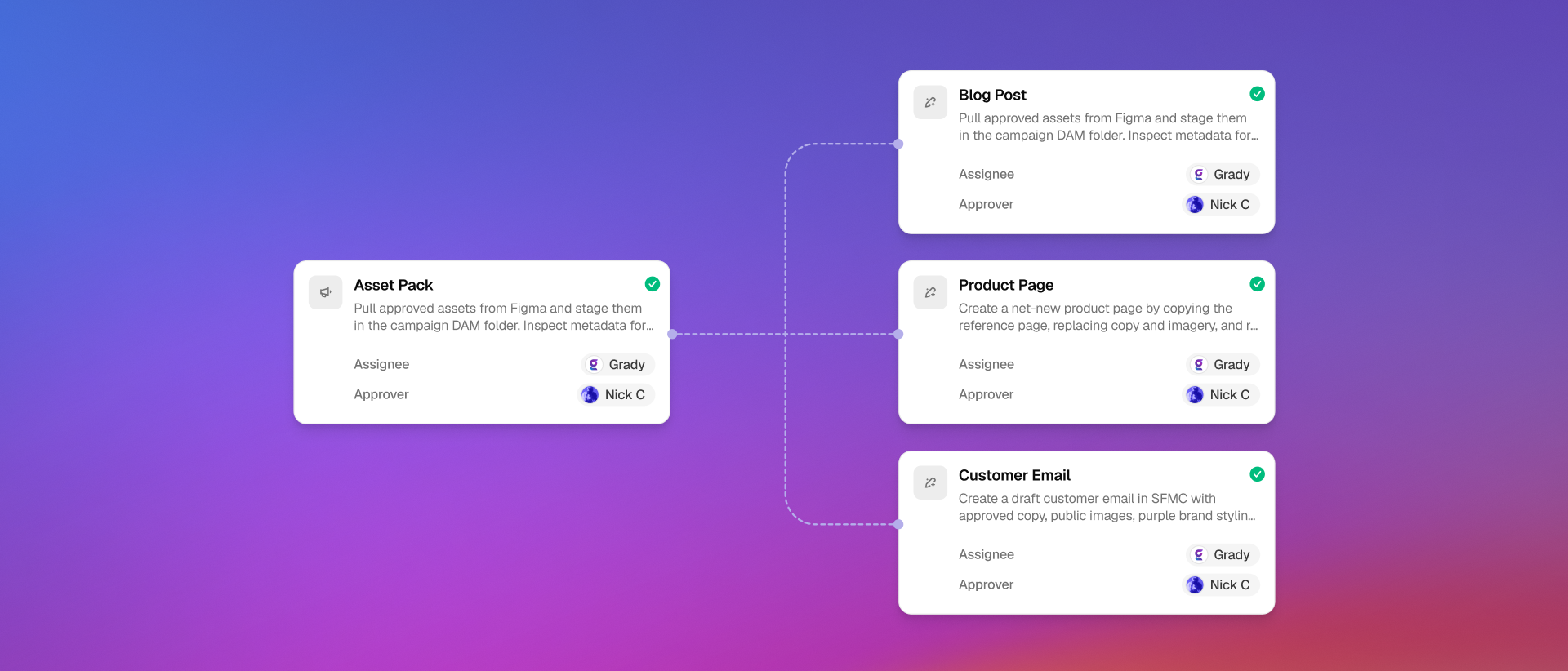
| Execution agent | Prepare authorized changes in CMS, DAM, workflow, analytics, and related systems | Scoped identity, change limits, previews, protected live actions |
| Evaluation agent | Run deterministic and model-based checks, compare before and after, flag exceptions | Versioned criteria, test data, human review for ambiguity |
| Measurement agent | Repeat the stable prompt set and connect results with experience, operations, and cost | Baseline integrity, observation windows, no causal overclaiming |
The orchestrator should invoke only the roles needed for the gap. More agents add context transfer, latency, failure paths, and cost. Use deterministic checks for stable rules. Use agents where interpretation, research, synthesis, planning, or exception handling creates value.
Govern brand, access, quality, and spend from one command center
Enterprise autonomy depends on visible controls. The command center should show what work is running, which context governs it, what systems it can touch, what it costs, where it is blocked, and who can authorize the next action.
Governed context
Version brand guidance, product facts, customer proof, legal requirements, market rules, taxonomy, page models, prior decisions, and agent feedback. Record which versions a run used. An agent should not silently replace an approved source with an older page or a general web summary.
Identity, permissions, and environments
Give every agent a scoped identity and the minimum access required. Reading a public page, preparing a draft, changing a canonical, updating asset metadata, and releasing live content require different authority. Separate draft, approval, and live boundaries.
Quality and approval
Build factual, brand, accessibility, SEO, technical, and portfolio checks into the workflow. Route only the remaining judgment to people. Keep approval proportional to risk, with mandatory human decisions for new public claims, high-impact templates, redirects, canonical changes, regulated content, and publication.
Agent and model spend
Set limits by organization, workspace, program, workflow, provider, and agent. Control prompt volume, context length, model choice, tool calls, steps, retries, and recursion. Define the threshold behavior before execution: stop, use a lower-cost path, narrow scope, or request approval.
Observability and recovery
Record sources, plans, model and tool usage, changes, validations, approvals, cost, errors, retries, and final state. Define stop conditions and rollback paths. A successful final outcome should not erase the failures that occurred on the way there.
Control AI search economics by measuring cost per verified outcome
Token spend alone is not a useful program metric. The least expensive model can create costly rework, while a higher-cost evaluation can prevent a risky release. Measure the complete unit of work.
For each intervention, capture:
- Prompt-monitoring and provider cost
- Model and context cost for diagnosis, planning, drafting, and evaluation
- Tool and infrastructure cost
- Human research, review, legal, engineering, and release time
- Rework caused by factual, brand, technical, or workflow defects
- Cycle time from observation to verified live result
- Whether the result was approved, released, reversed, or abandoned
Then compare cost per approved brief, resolved gap, verified page change, corrected answer, or sustained visibility improvement. This gives leaders a better basis for model routing, agent autonomy, vendor selection, and program expansion.
Organize the enterprise around decisions, not a new silo
AI search operations needs clear accountability across functions, but it does not require a separate team to own every action.
| Function | Primary responsibility |
|---|---|
| Marketing or digital leadership | Set priority audiences, business outcomes, investment limits, and risk appetite. |
| SEO and AI search lead | Own the prompt portfolio, measurement model, gap taxonomy, source ownership, and prioritization. |
| Content strategy and editorial | Own usefulness, narrative, evidence, expertise, page roles, and maintenance. |
| Web and content operations | Own CMS execution, components, assets, workflow routing, preview, and release readiness. |
| Technical SEO and engineering | Own access, rendering, indexation, structured data, performance, canonicals, and platform constraints. |
| Brand, legal, security, and compliance | Define reusable rules and decide exceptions or high-risk claims. |
| Communications, customer, and partner teams | Maintain public facts, research, proof, earned-source relationships, and correction paths. |
| Analytics and finance | Connect visibility with experience, operations, business impact, and total program cost. |
One accountable program owner should decide priorities and resolve conflicts. Work can remain distributed as long as the evidence, requirements, owners, dependencies, approvals, and outcomes stay connected.
Six practical playbooks for common AI search gaps
1. The brand is absent from a high-value answer
Confirm the prompt reflects a real customer decision. Identify which sources currently shape the answer. Determine whether an existing page can satisfy the need or whether a new source deserves to exist. Build a specific, evidence-rich answer, connect it to the site architecture, validate access, and observe over time.
2. The brand is mentioned but not cited
Compare the cited third-party sources with the strongest owned page. Look for specificity, evidence, extractability, canonical clarity, and authority differences. Improve the owned source as a reference, not only as a conversion page. Do not assume that adding schema alone will create citation authority.
3. The answer is inaccurate or outdated
Correct the canonical source and all reusable records first. Add visible dates and precise language. Identify conflicting owned pages and influential public sources. Use legitimate correction or update channels. Recheck several providers because stale information can persist differently across systems.
4. A third party owns the category narrative
Study what makes the source useful. Create better primary evidence, research, expert detail, and comparison guidance on the owned domain. Strengthen legitimate publisher, partner, analyst, community, and customer education with verifiable material. Avoid manufacturing reviews, citations, or consensus.
5. Priority content is inaccessible
Pause content production. Resolve response, bot-policy, rendering, canonical, and indexation problems first. Verify the fix on the live experience and monitor for regression after security, CDN, and front-end releases.
6. The organization has hundreds of known gaps
Cluster by gap type, page model, topic owner, risk, and reusable intervention. Start with a small, high-value batch. Use agents to prepare repeatable changes, deterministic checks to validate stable rules, and human approval for exceptions and live release. Expand only when the batch produces reliable quality and economics.
A 90-day roadmap for enterprise AI search operations
Days 1 to 30: establish the evidence and controls
- Select one audience, market, product area, or customer journey.
- Create a stable core prompt set and an exploratory set.
- Observe across relevant providers and capture cited sources.
- Define the eight-gap taxonomy, source ownership, baseline metrics, and review cadence.
- Map crawler policy, CMS and DAM paths, approval owners, and model or tool budgets.
- Choose five to ten opportunities with clear business relevance and manageable risk.
Days 31 to 60: execute controlled interventions
- Create evidence-linked briefs with one primary gap and a testable hypothesis.
- Use agents to prepare content, technical, structured-data, and internal-link changes in draft.
- Run factual, brand, accessibility, technical, SEO, and portfolio checks.
- Route required reviewers with before-and-after evidence, exceptions, and total cost.
- Release only approved work, then verify the rendered and crawlable result.
Days 61 to 90: measure and scale the operating model
- Repeat the stable prompt set and compare representation, authority, and source mix.
- Review experience, operations, quality, and cost signals.
- Document which gap diagnoses and intervention patterns were correct.
- Convert repeatable fixes into governed workflows and reusable agent context.
- Expand to the next topic or page model only after quality, recovery, and economics are understood.
The first 90 days should prove that the organization can complete the loop. It should not attempt to monitor every possible prompt or rewrite the entire website.
How to evaluate an enterprise AI search operations platform
Ask vendors and internal teams to demonstrate the full workflow on a real gap.
- Observation: Can it preserve prompts, answers, citations, provider, date, and source evidence?
- Diagnosis: Can it distinguish content, technical, authority, accuracy, freshness, and portfolio gaps?
- Source ownership: Can it compare the current site and identify where the answer should live?
- End-system action: Which CMS, DAM, workflow, analytics, search, collaboration, and data systems can it read and change?
- Open ecosystem: Can the organization use the models, agents, tools, and data sources that fit each job?
- Reusable context: How are brand, product facts, proof, policies, page models, and feedback maintained and versioned?
- Orchestration: Can it manage owners, dependencies, parallel work, blockers, retries, and human review?
- Governance: Can administrators control identity, permissions, environments, models, tools, budgets, approvals, and exceptions?
- Evidence and recovery: Can reviewers see sources, changes, checks, spend, failures, and rollback options?
- Verification: Does it inspect the final saved and rendered experience before claiming completion?
- Measurement: Can it connect the shipped change to AI representation, citations, customer behavior, operational efficiency, and cost?
A polished answer or dashboard is not a sufficient test. The platform should close a bounded gap under the organization's real controls.
How Gradial turns AI search visibility into governed action
Gradial is the marketing operations system of work for enterprises. For GEO and AEO, its role is to connect AI-search evidence with the operational systems, context, agents, and approvals required to act.
- Evidence becomes executable work: AI-search observations can become scoped workflows with sources, owners, dependencies, budgets, and acceptance criteria attached.
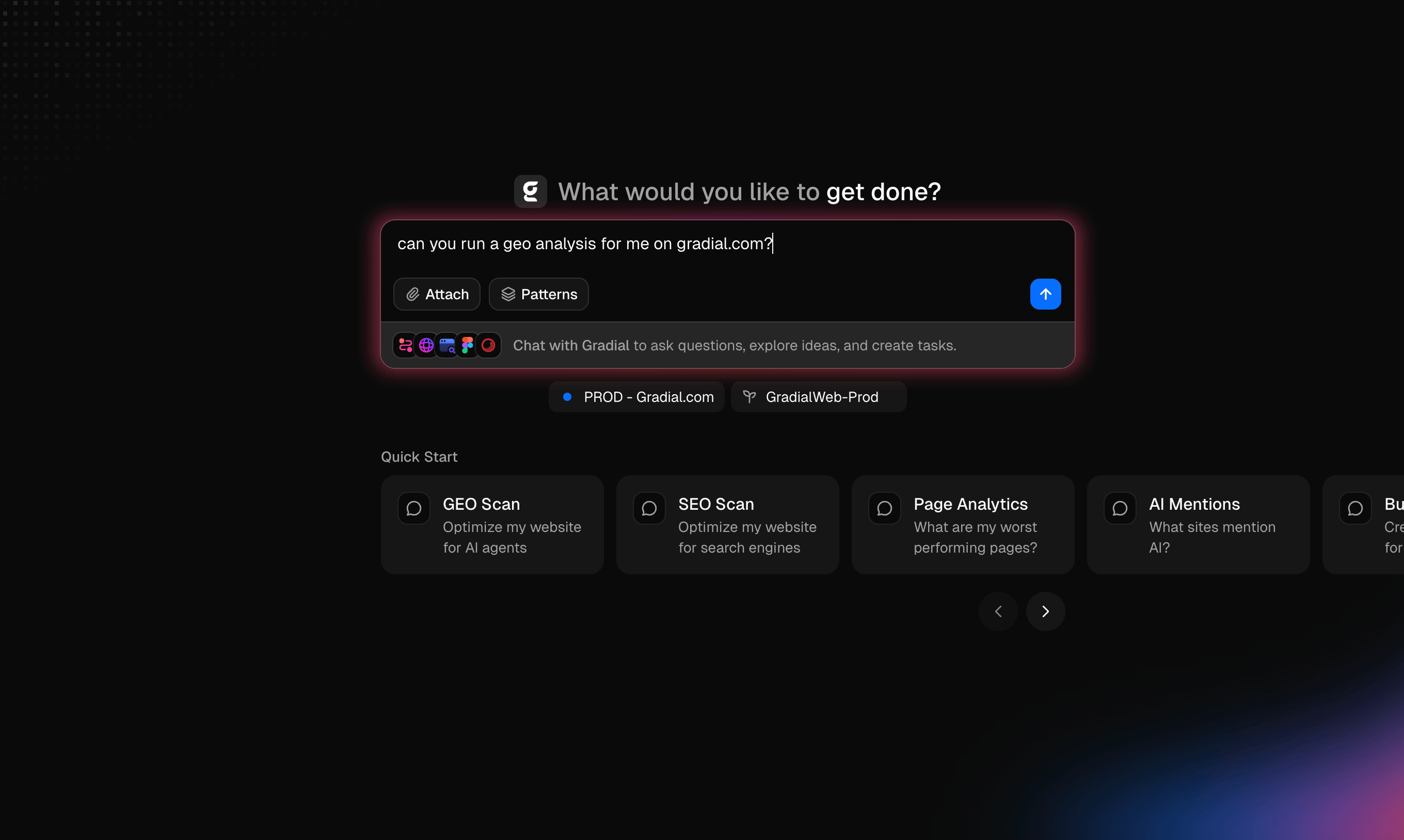
- Agents execute in end systems: Gradial agents can prepare authorized changes across connected CMS, DAM, workflow, analytics, copy, and collaboration systems instead of stopping at a recommendation.
- The ecosystem stays open: Enterprises can bring the models, agents, tools, data, and systems that fit each job while preserving one governed operating layer.
- Context stays reusable: Agentic content infrastructure carries approved brand, business, content, workflow, and governance context through research, planning, execution, QA, and review.
- Brand and spend stay controlled: Permissions, model and tool policy, token and workflow budgets, approval points, and exceptions remain visible through a command-center view.
- The result is verified: Work is checked in stored state and, when a rendered experience exists, in the visible page before the workflow measures impact.
This closes the gap between knowing where AI search is weak and building the continuous execution capacity to improve it.
Frequently asked questions about GEO, AEO, and AI search operations
What is generative engine optimization (GEO)?
GEO is the practice of improving whether and how a brand, product, entity, or topic appears in AI-generated answers, including the sources those answers cite. It combines content, technical, authority, entity, and measurement work.
What is answer engine optimization (AEO)?
AEO focuses on making information clear, accurate, trustworthy, and easy for answer systems to interpret and attribute. In enterprise practice, AEO and GEO overlap heavily.
How is GEO different from SEO?
SEO focuses on discoverability and performance in search engines. GEO focuses on representation and citations in generated answers. They share crawlability, indexability, usefulness, authority, entities, links, and technical quality, but the measurement and source behavior differ.
How can a website improve its chances of appearing in ChatGPT search?
OpenAI documents OAI-SearchBot as the crawler used to surface websites in ChatGPT search and provides separate controls for search crawling and model-training crawling. Sites should make deliberate crawler-policy decisions, keep priority content accessible, publish useful and authoritative answers, and maintain clear canonical sources. Inclusion is never guaranteed.
Does AI search require special schema or an llms.txt file?
Google says no special AI file or unique schema is required for its AI features. Accurate structured data that matches visible content can clarify meaning, but it is not a substitute for useful content and sound technical foundations. Organizations can experiment with emerging conventions, but they should not treat them as universal requirements without provider support.
Why do AI systems mention a brand but cite another website?
Brand recognition and source authority are different. A third-party page may answer the question more directly, provide clearer evidence, compare alternatives, render more reliably, or be easier to extract. Diagnose the source difference before choosing a fix.
What should enterprise teams measure?
Measure presence, representation accuracy, owned citations, cited-source mix, competition, experience outcomes, operational cycle time, quality, and total cost per verified outcome. Keep a stable prompt set so changes can be compared over time.
What can AI agents do for GEO and AEO?
Agents can run approved prompt sets, classify gaps, compare sources, prepare briefs, draft content, inspect technical readiness, execute authorized changes in connected systems, run checks, route review, and measure results. They need shared context, scoped permissions, budgets, evidence, stop conditions, and human accountability.
Should AI agents publish GEO changes autonomously?
Only within an explicit risk and approval policy. Most enterprises should keep human approval for new public claims, regulated content, major page changes, redirects, canonical changes, high-impact templates, and publication. Draft preparation and low-risk deterministic repairs can gain autonomy after quality and recovery behavior are proven.
Can GEO guarantee citations or top placement in AI answers?
No. Answer engines decide what to retrieve, trust, cite, and display. A strong operating model can improve usefulness, authority, technical access, execution speed, and measurement, but it cannot guarantee inclusion or placement.
Sources, methodology, and update scope
This guide combines current public platform guidance, agent-design and AI-risk principles, Gradial product documentation, and Gradial's first-party AI search studies. Key sources include:
- Google Search Central, “AI features and your website”, updated December 10, 2025. Google states that established SEO foundations remain relevant for AI Overviews and AI Mode, with no special AI markup required.
- OpenAI crawler documentation, accessed August 5, 2026. OpenAI documents separate controls for OAI-SearchBot, GPTBot, and user-initiated ChatGPT access.
- Anthropic, “Building effective agents”, published December 19, 2024. The article recommends simple, composable agent patterns and explicit attention to cost, latency, and error tradeoffs.
- NIST AI 600-1, Generative AI Profile, published July 26, 2024 and updated April 8, 2026. The profile addresses trustworthiness across the design, development, use, and evaluation lifecycle.
- Gradial retail AI search visibility study, covering 28 brands and more than 1,600 data points.
- Gradial higher-education AI search visibility study, covering 51 institutions and more than 7,000 data points.
- Gradial travel and hospitality GEO study, covering 55 brands and more than 7,700 data points.
- Gradial airline AI visibility study, covering more than 20 airlines and more than 1,260 searches.
- Current Gradial GEO, workflows, security and governance, and platform pages for product facts and operating patterns.
AI search systems, crawler controls, source preferences, and answer behavior change frequently. This guide was reviewed on August 6, 2026. Teams should validate provider-specific requirements against current documentation and treat visibility observations as time-bound evidence.
What a first governed AI search workflow should produce
- One stable prompt portfolio tied to a real audience, decision, market, and business priority.
- One baseline that separates presence, representation, authority, experience, operations, and economics.
- One clearly classified gap with an owned source, evidence, hypothesis, destination system, and accountable owner.
- One approved change executed in the correct end system with factual, brand, technical, accessibility, and portfolio checks attached.
- One verified live result, repeated observation, total cost record, and decision to keep, refine, expand, or reverse.
- Explore GEO execution: See how Gradial connects AI-search observations to prioritized, governed content changes.
- See governed workflows: Learn how people, agents, systems, dependencies, and approvals move together.
- Map your AI search operating loop: Bring one visibility gap and trace the path from evidence to a verified change in your stack.