

The Best Use of AI Agents Is Getting Closer to Your Customers
Quick confession: I'm a DIY marketer. I'd rather build the thing myself than hand it off.
Not because I think specialists are overrated. It's because every time I stay close to the work, I stay close to the reason we're doing it. And every time I hand it off, a little of that reason leaks out.
AI agents made that instinct a lot cheaper to act on. I can pull data, scaffold a campaign, audit a database, shape an audience, and turn a half-formed idea into something executable in an afternoon. No ticket. No backlog. No "we'll get to it in two sprints."
Everyone talks about that as speed. Speed is nice. It's not the point.
The point is continuity.
Think about what happens to a campaign idea on its way to launch. Idea becomes brief. Brief becomes deck. Deck becomes project plan. Project plan becomes a dozen channel requests. By the time anything goes live, the insight that started it is a rumor.
Agents shrink that distance. One person can stay on the idea from the first sentence to the thing a customer actually sees.
Which raises the real question, the one almost nobody asks before they start automating:
What are you going to do with the time?
What's the productivity trap?
Here's what I see happen, over and over.
A team adopts agents. The pitch is "this frees us up for the meaningful work." Everyone nods. Then three months in, the measure of success is how much extra stuff fit into the week.
More campaigns. More content. More segments. More tests. More.
That's the trap. You automated production and then expanded the production queue, and now you've got a marketing team that's more efficient and less connected to customers than it was before. That's not a win. That's a treadmill with better software.
Because the most valuable thing a marketer can know isn't a persona. It isn't a segment label. It's the actual human on the other end, living with a problem, weighing tradeoffs, and quietly deciding whether your company gets it.
So here's my take: the highest-value use of the time agents give back is getting closer to that person. Everything else is optional.
Does human expertise matter less now?
You've heard the line. "AI output is only as good as the prompt."
People say it like it's a limitation of the technology. I read it the other way. It's proof that knowing things still matters.
Some stuff you only learn by being there:
- Hearing a customer say one objection on a call and realizing the real one is something else entirely
- Watching a campaign crush it on paper and having no idea why anyone bought
- Making a call, being wrong, living with it, and adjusting
That experience shapes what you ask for, what you notice, what you push back on, and what you refuse to ship. An agent can't do that for you. It can only work with what you bring.
Which means the marketer's job is tilting toward judgment. Understanding customers. Finding the insight under the obvious answer. Picking priorities. Protecting the original intent while an idea turns into an experience.
The better agents get at execution, the more your inputs matter. Not less. More.
Which work should agents own?
Let me get specific, because "give agents the busywork" isn't advice.
Two things changed my week the most: campaign operations and database work.
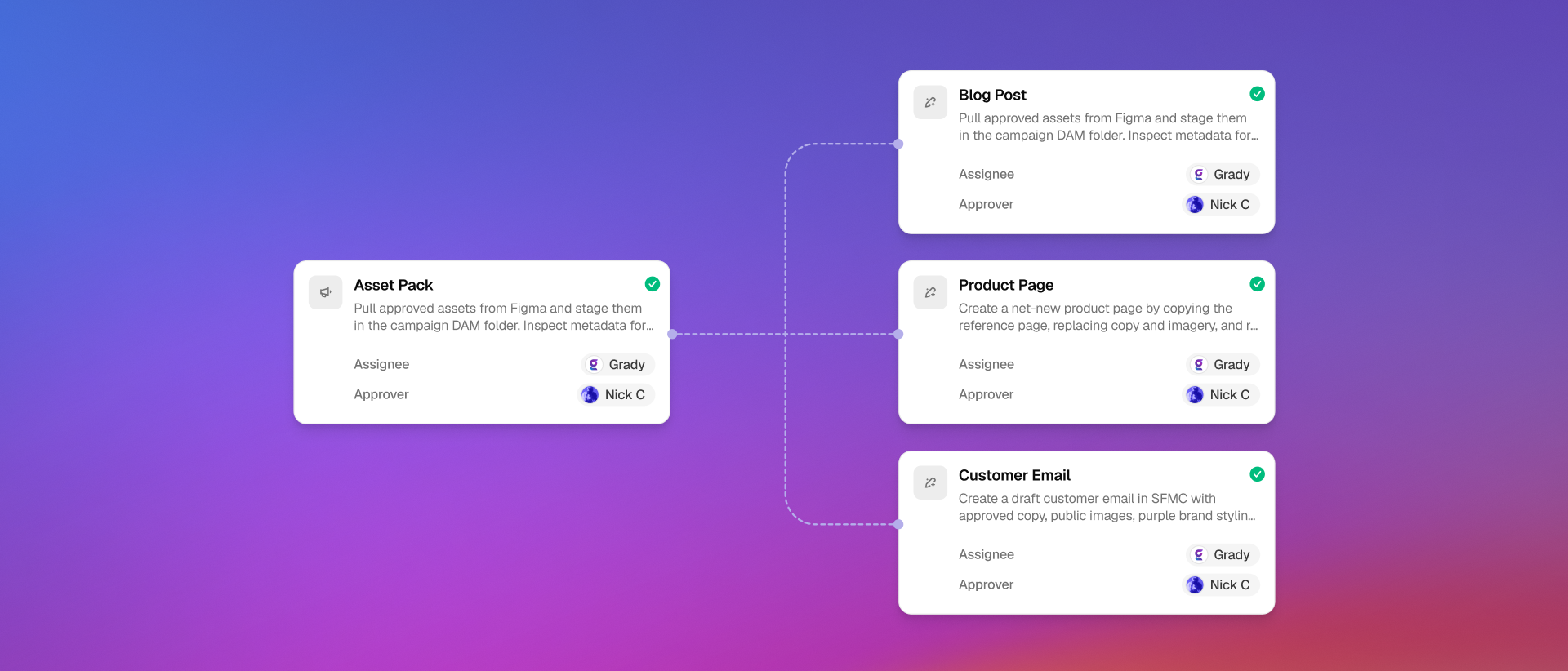
Campaign ops. I used to take the same information and reformat it five or six times. Execution brief. Internal deck. PM ticket. Design concepting doc. Results readout. A handful of smaller handoffs. None of that was thinking. It was translation.
Database and segmentation. Auditing, cleaning, cutting lists. Essential, slow, manual, and the first thing to get dropped when capacity got tight. Agents turn that from "when we get a chance" into "every week."
Why those two? They're operationally necessary, they're repeatable, and the context behind them can be written down. That's the test for what to hand off.
And the time that comes back has to go somewhere. For me:
- Listening to sales calls
- Talking to customers and prospects directly
- Studying the exact words customers use
- Reviewing why deals move or stall
- Checking whether our internal assumptions match what people are actually going through
The split, in three lines:
- Agents get the information-moving work. Reformatting briefs, assembling inputs, routing tasks, updating systems, pulling recurring data, checking defined requirements.
- Humans keep the understanding-building work. Customer conversations, interpretation, positioning, creative judgment, prioritization, anything that depends on lived context.
- Human learning feeds back into agent work. What you learn about customers becomes better instructions, sharper workflows, tougher review criteria, more relevant execution.
Is that boundary permanent? No. Tasks will slide across it as the technology improves. The rule that doesn't change: use agents to reduce your distance from customers. Never to increase it.
How should you measure leverage?
Nothing about the actual job changed. You still have to connect data across too many platforms. Still have to turn insight into campaigns that respect where someone is. Still have to decide what to say, where, and whether it's worth saying at all.
Agents change how fast you can act on all that. They don't change what you're trying to do.
So output volume is a bad scoreboard. Here's a better one. Five questions, end of every month:
- Did we learn something new about the customer?
- Did that insight survive all the way through execution?
- Did we remove repetitive work without lowering the quality bar?
- Did we create time for marketers to listen, think, and decide better?
- Did the customer get something more useful than they would have otherwise?
If the answers are all no, you didn't improve your marketing. You automated a workflow. Those are different things, and only one of them shows up in results.
Bottom line: marketers who use agents to produce more will get faster. Marketers who use them to get closer to customers will get better.
I'm trying to land on the second one. Agents carry more of the operational load, and I spend more of my week on the work that justifies running the operation in the first place.
Your move: pick one repetitive workflow this month and hand it off. Then take the hours you get back and spend them on a sales call recording. Not on another campaign. A sales call. See what you hear.